The Suicide of Self-Respect
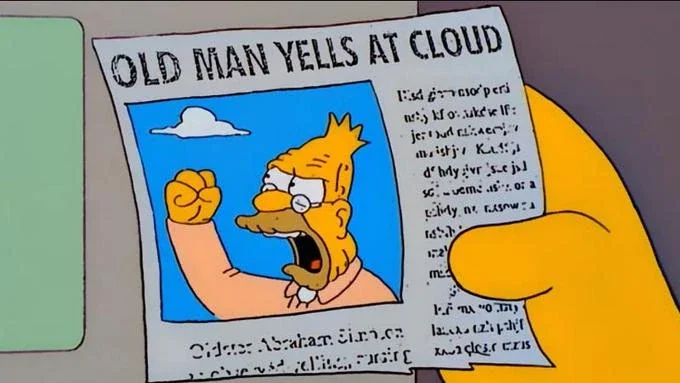
Before I say anything else, I want to say up front that I am Grandpa Simpson in this meme; and that beyond being a crank, I recognize that I am probably more than a little bit arrogant. It is possible that I should have less self-respect, or rather self-regard, at the same time that others might benefit from having a little more.
Increasingly I look around me (largely on the internet, which is perhaps a mistake) and feel I am witnessing a mass suicide of self-respect, impacting the full breadth of society in myriad ways. And I am not talking about people beclowning themselves through ordinary ignorance or the limits of their intelligence (indeed, a lack of intelligence in no way merits a lack of respect, self-directed or otherwise); neither am I accusing people of silliness – I myself am incorrigibly silly and have little use for vacuous self-seriousness. I am talking about having respect for one’s own intelligence, however limited, and more importantly, for one’s own integrity, however compromised we find ourselves on any given morning. The tragedy of a body of lemmings leaping to their doom is not simply that they somehow manage to break their tiny bodies upon the rocks (how they do this, being small, eludes me), but also that there is no good reason for them to make that leap. That senselessness is what unites all the different ways in which people voluntarily embarrass themselves (and doubly, by neglecting to actually feel embarrassed).
I call this the suicide of self-respect specifically because the thing which I first taxonomized as a bugbear of this sort was the spread of algospeak, that ridiculous tendency of people to internalize the ways in which social media algorithms privilege or censor certain words, leading them into infantile euphemisms. The most famous example, of course, is the avoidance by content creators on TikTok of the term “suicide”, and to a degree “kill,” “murder,” etc., all replaced by the obscene Newspeak “Unalive.” This is very different from youth slang, designed to confuse and elude parents – that kind of linguistic innovation is human and natural. This, on the other hand, enslaves the vocabulary to the whims of techno-capitalist advertisers, and reduces language to a quivering, cringing rabbit hiding from the algorithm. Not only does it debase the tongue of the speaker, its tendency to render grave subjects into ridiculous childlike malapropisms disrespects the gravity of those subjects, which is a real moral risk to how we think of these things. You cannot call killing “unaliving” or rape “grape” and continue to regard these things in the stark light of moral reality. And even if you can preserve your own perception against the impoverishment of your language, your hearers cannot possibly take you seriously or respect you.
Speaking of algorithms, so much of what I observe now is related to technology, to the adoption of generative AI. I am not making a blanket condemnation of the technology; I enjoy silly brainrot memes generated as AI slop as much as the next person; low humor is the appropriate venue for the technology. But as more and more people use AI to do more of their thinking for them, they disrespect their own intellects, and when they use it to whip up text which they expect humans to read, they render themselves mute and disrespect their readers. I feel personally disrespected by every instance where someone expects me to read a text that they did not bother to write. But I’m, not surprised people would reach for the easy button, especially not with things they don’t care very much about – though that is an avenue toward nobody caring at all. What shocks me are the people who find AI slop an acceptable substitute for human art – not low humor, but actual narrative entertainment, or aesthetically-pleasing art. I see so many people being impressed by AI vomit, and choosing to consume it; and I am sure I have or will be taken in myself by some AI-generated song or image that happens to strike me the right way on the wrong day – and I consider that personally disrespectful.
I am also afraid here – because while I am deeply dug-in and quite stubborn, I am afraid of eventually being swept away by economic pressure into using AI in ways I now abhor, otherwise finding the middle-class life I expect priced out of possibility by the arms race to the cheapest, fastest, short-term quarterly returns. I’ve hardly any tolerance for basic inconvenience, much less economic martyrdom. Perhaps this just masks the real fear – that I know my own weakness, and expect I will probably mellow and make excuses and erode my resolve over time, until I no longer respect myself.
Technology is far from the only arena in which this phenomenon runs rampant; another is the collapse of the shared epistemic order. People who were once serious citizens of their communities have blinkered themselves into a sludge of conspiracy theories that would have gotten them laughed out of the room twenty years ago. This may sound like me mocking ignorance, but it is actually a matter of standards – we used to treat antivaxxers like flat-earthers, and there was a broadly shared understanding of which news sources were credible and which were tabloids. What has changed is that people have decided to believe that they know better than the experts, and are crowdsourcing their epistemology to their self-selected bubbles. It’s not a case of being lied to, it’s a case of mutual sycophancy among communities of people all telling themselves the same lies. Perhaps that is ignorance, to some degree; perhaps that is not so different from how God sees our self-deception as sinners with stupid priorities; but it still feels to me like people disrespecting their own intelligence for reasons that escape me.
Conspiratorial thinking obviously plays a huge role in our politics, but this suicide of self-respect has another avenue through which it intrudes on politics. Not only do politicians beclown themselves by acting shamelessly and embracing conspiracy theories, but their supporters and even their reluctant partisans embarrass themselves by pretending that the worst of these leaders nevertheless should be taken seriously, or that things are normal, when the Emperor is quite plainly nude. A refusal to acknowledge reality runs through so many of these cases. It is the ultimate form of self-disrespect to declare that two plus two is five, and that is where the spectrum that begins with stupid euphemisms ends.
Finally, all of these are in their purest form symptoms of the disappearance of shame. People do not respect themselves enough to be embarrassed when pretending things are otherwise than they plainly are. This spills over into disrespect toward others. There has been much discourse about high- and low-trust societies, and at the root of the low-trust society is disrespecting others and oneself at the same time, by knowing oneself to be shameless, and presuming that everyone else will be shameless also. Often the moral shamelessness of one person occasions the moral shamelessness of others: every time a news story sadly reports on some crime or scam in a country that people hold negative stereotypes of, often because it does suffer from the many ills of a low-trust society, this shameless behavior of a few people produces its own echo of online bigots who mock their own intelligence by heaping general abuse on whole populations and demographics because of the actions of individuals. Truly they all deserve each other.
But perhaps the worst form of self-mockery is to elevate oneself above others, Satan perched on his Miltonic rock. Despite lampshading my arrogance, I’m still complaining about my peers and their loss of self-respect, when what I should worry about is my lack of respect for them.
