Books I Read in 2025
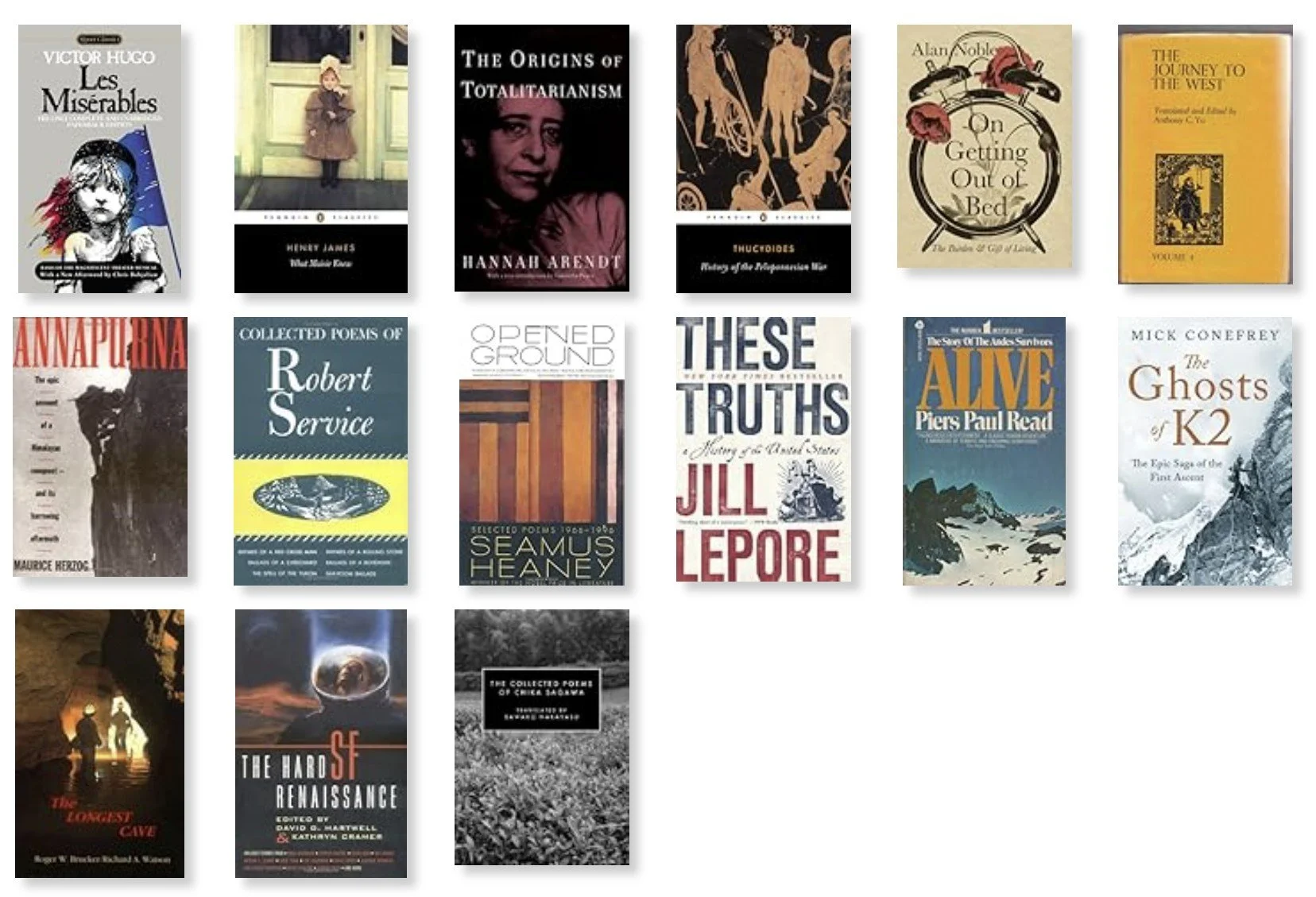
I read 15 books in 2025, which I’m going to rank, but I’ll start with the caveat that none of these were bad. I don’t often read bad books, so don’t read too much into the ranking at the low end. Here is the list: https://www.goodreads.com/review/list/118209919-andrew-bell?shelf=read-in-2025&view=covers
15. The Collected Poems of Chika Sagawa, Chika Sagawa, 1936
Modernist poetry perhaps suffers more in translation than other forms of poetry – or perhaps this is too avant-garde for me to really assimilate. I struggled to connect with these, but they still provide honest and vulnerable glimpses of light from a mind who died far too young and produced an impressive amount of serious verse in her 25 years of life.
14. The Hard SF Renaissance, Anthology, 2002
This is a fascinating collection of science fiction stories. I find that the worldview common to so much hard SF in this period is so bleak and troubling on a philosophical level that I fixate on each story less as science fiction and more as a kind of intellectual horror, which makes them more compelling, if also disturbing to consider as possibilities.
13. The Longest Cave, Roger Bruckner & Richard Watson, 1975
Fun and freewheeling in a way that almost makes you forget that the authors are insane mole-men whose idea of a good time is worming their way miles deep in the unmapped earth through tubes so small that you can’t even crawl properly on hands and knees, but have to slither. As someone morbidly fascinated by the (vicarious) claustrophobia of caving and the romantic danger of extreme exploration, and who also loves extremely detailed and thoroughly-mapped step-by-step accounts of that process of exploration, this is a real good time. I’m glad the authors didn’t die and surfaced long enough to write this book.
12. The Ghosts of K2, Mick Conefrey, 2015
Another very detailed step-by-step account of the process of exploration, this time in the vertical. I’ve been obsessed with expeditions in the Himavant since seeing an IMAX documentary on Everest at the Pacific Science Center as a kid. I was particularly captivated by the fate of Dudley Wolfe, who was good at climbing up and tolerating the altitude, but perhaps felt less surefooted going back down, and so gradually camp-by-camp ratcheted himself higher and higher on the mountain, declining to descend when the others did, waiting out the bad weather high up, spending four weeks above 23,000 feet, and ultimately dying on the mountain, never to be found, and taking his would-be rescuers with him. It combines the spiritual awe of the pilgrimage of ascent with the reverential horror reserved for the slow process of someone walking to their own death, growing weaker and less sane with every step, but too slowly to notice and pull back.
11. Alive, Piers Paul Read, 1973
A story of survival where the headline that draws people in is cannibalism, but the actual story is a kind of total refutation of Lord of the Flies in which a group of young men rise to the unthinkable circumstance which confronts them, form an orderly community amid the ice, and in the house of death come to clearly see the face of God.
10. These Truths, Jill Lepore, 2018
A worthy stab at the project of fashioning American history into myth – a very reasonable and measured liberal myth which attempts to hold together the good and the bad at once, which so many fail at or simply do not attempt, but which is a crucial endeavor if we are to have any hope of a country with both a bright future and a just one.
9. Opened Ground, Seamus Heaney, 1995
The way I read poetry, trying to progress measurably through a book while reading aloud, is perhaps in tension with this style, which does not run rapidly down the tongue. The smell of the damp earth, however, is still in my nostrils. And I found both useful and affecting the way in which he writes about how to write, how to work. See my review for quotes: https://www.goodreads.com/review/show/4451129167
Digging:
Between my finger and my thumb
The squat pen rests; snug as a gun.
Under my window, a clean rasping sound
When the spade sinks into gravelly ground:
My father, digging. I look down
Till his straining rump among the flowerbeds
Bends low, comes up twenty years away
Stooping in rhythm through potato drills
Where he was digging.
The coarse boot nestled on the lug, the shaft
Against the inside knee was levered firmly.
He rooted out tall tops, buried the bright edge deep
To scatter new potatoes that we picked,
Loving their cool hardness in our hands.
By God, the old man could handle a spade.
Just like his old man.
My grandfather cut more turf in a day
Than any other man on Toner’s bog.
Once I carried him milk in a bottle
Corked sloppily with paper. He straightened up
To drink it, then fell to right away
Nicking and slicing neatly, heaving sods
Over his shoulder, going down and down
For the good turf. Digging.
The cold smell of potato mould, the squelch and slap
Of soggy peat, the curt cuts of an edge
Through living roots awaken in my head.
But I’ve no spade to follow men like them.
Between my finger and my thumb
The squat pen rests.
I’ll dig with it.
8. Collected Poems of Robert Service, Robert Service, 1906
Robert Service holds a special nostalgia for me from childhood dreams of the Klondike, now bolstered by the added interest of actually living in the North. I write about this in my blog: https://www.andrewroosbell.com/blog/the-bard-of-the-yukon
7. Annapurna, Maurice Herzog, 1950
A personal and yet personally unsympathetic account of the grand misery of mountaineering. I am so fascinated by the attempt to unfold and pry apart the path into the contorted spires of a reclusive massif made solely through the reckless sacrifice of the human body. Herzog was crazy. I was very happy to follow along on Google Earth, but that is as far as I go.
6. Journey to the West, Wu Cheng’en (?), 1592
You would think the repetition of the pattern of binding and liberating would grow tiresome, yet it never does; for that we must thank the luxury of the poetry, the fundamentally compelling nature of the theme of overcoming evil, and most of all, Sun Wukong for being a delight.
5. On Getting Out of Bed, Alan Noble, 2023
I have found great encouragement in the wisdom in this book, and the frank acknowledgment that life is lived in the face of death, which helps to deal with the daily experience of misery and futility. We must live, regardless! More here: https://www.andrewroosbell.com/blog/on-getting-out-of-bed
4. History of the Peloponnesian War, Thucydides, 411 BC
This feels like it could have been written about our world today and it would play out almost exactly the same. The fact that Thucydides is so spare in his commentary, and yet pours his entire life's somber perspective into it, without ever making it about himself, but only about passing on this one piece of wisdom, which cost so many lives to procure, compels reverence. This also gives us the Melian Dialogue, the aphorism of amoral power in foreign relations, which we must gaze into like the fire, and then reject fully as a way of making policy: “you know as well as we do that right, as the world goes, is only in question between equals in power, while the strong do what they can and the weak suffer what they must.”
3. The Origins of Totalitarianism, Hannah Arendt, 1950
One of the most impressive and startling books I’ve read, and one I continue to think about. More here: https://www.andrewroosbell.com/blog/the-origins-of-totalitarianism
2. What Maisie Knew, Henry James, 1896
This is one of the best novels I've ever read. There's nothing so astonishing as James's prose, hard and crystalline and expansive as ever, placed fully at the service of a realistic child's perspective.
“The litigation had seemed interminable and had in fact been complicated; but by the decision on the appeal the judgment of the divorce-court was confirmed as to the assignment of the child. The father, who, though bespattered from head to foot, had made good his case, was, in pursuance of this triumph, appointed to keep her: it was not so much that the mother’s character had been more absolutely damaged as that the brilliancy of a lady’s complexion (and this lady’s, in court, was immensely remarked) might be more regarded as showing the spots. Attached, however, to the second pronouncement was a condition that detracted, for Beale Farange, from its sweetness – an order that he should refund to his late wife the twenty-six hundred pounds put down by her, as it was called, some three years before, in the interest of the child’s maintenance and precisely on a proved understanding that he would take no proceedings: a sum of which he had had the administration and of which he could render not the least account. The obligation thus attributed to her adversary was no small balm to Ida’s resentment; it drew a part of the sting from her defeat and compelled Mr. Farange perceptibly to lower his crest. He was unable to produce the money or to raise it in any way; so that after a squabble scarcely less public and scarcely more decent than the original shock of battle his only issue from his predicament was a compromise proposed by his legal advisers and finally accepted by hers.
His debt was by this arrangement remitted to him and the little girl disposed of in a manner worthy of the judgment-seat of Solomon. She was divided in two and the portions tossed impartially to the disputants. They would take her, in rotation, for six months at a time; she would spend half the year with each. This was odd justice in the eyes of those who still blinked in the fierce light projected from the tribunal – a light in which neither parent figured in the least as a happy example to youth and innocence. What was to have been expected on the evidence was the nomination, in loco parentis, of some proper third person, some respectable or at least some presentable friend. Apparently, however, the circle of the Faranges had been scanned in vain for any such ornament; so that the only solution finally meeting all the difficulties was, save that of sending Maisie to a Home, the partition of the tutelary office in the manner I have mentioned. There were more reasons for her parents to aggree to it than there had ever been for them to agree on anything; and they now prepared with her help to enjoy the distinction that waits upon vulgarity sufficiently attested. Their rupture had resounded, and after being perfectly insignificant together they would be decidedly striking apart. Had they not produced an impression that warranted people in looking for appeals in the newspapers for the rescue of the little one – reverberation, amid a vociferous public, of the idea that some movement should be started or some benevolent person should come forward? A good lady cam indeed a step or two: she was distantly related to Mrs. Farange, to whom she proposed that, having children and nurseries wound up and going, she should be allowed to take home the bone of contention and, by working it into her system, relieve at least one of the parents. This would make every time, for Maisie, after her inevitable six months with Beale, more of a change.
‘More of a change?’ Ida cried. ‘Won’t it be enough of a change for her to come from that low brute to the person in the world who detests him most?’
‘No, because you detest him so much that you’ll always talk to her about him. You’ll keep him before her by perpetually abusing him.’
Mrs. Farange stared. ‘Pray, then, am I to do nothing to counteract his villainous abuse of me?’
The good lady, for a moment, made no reply: her silence was a grim judgment of the whole point of view. ‘Poor little monkey!’ she at last exclaimed; and the words were an epitaph for the tomb of Maisie’s childhood. She was abandoned to her fate. What was clear to any spectator was that the only link binding her to either parent was this lamentable fact of her being a ready vessel for bitterness, a deep little porcelain cup in which biting acids could be mixed. They had wanted her not for any good they could do her, but for the harm they could, with her unconscious aid, do each other. She should serve their anger and seal their revenge, for husband and wife had been alike crippled by the heavy hand of justice, which, in the last resort, met on neither side their indignant claim to get, as they called it, everything. If each was only to get half, this seemed to concede that neither was so base as the other pretended, or, to put it differently, offered them as both bad indeed, since they were only as good as each other. The mother had wished to prevent the father from, as she said, ‘so much as looking’ at the child; the father’s plea was that the mother’s lightest touch was ‘simply contamination’. These were the opposed principles in which Maisie was to be educated – she was to fit them together as she might.”
1. Les Miserables, Victor Hugo, 1862
One of the best books I have ever read. https://www.andrewroosbell.com/blog/les-miserables
