The Final Word
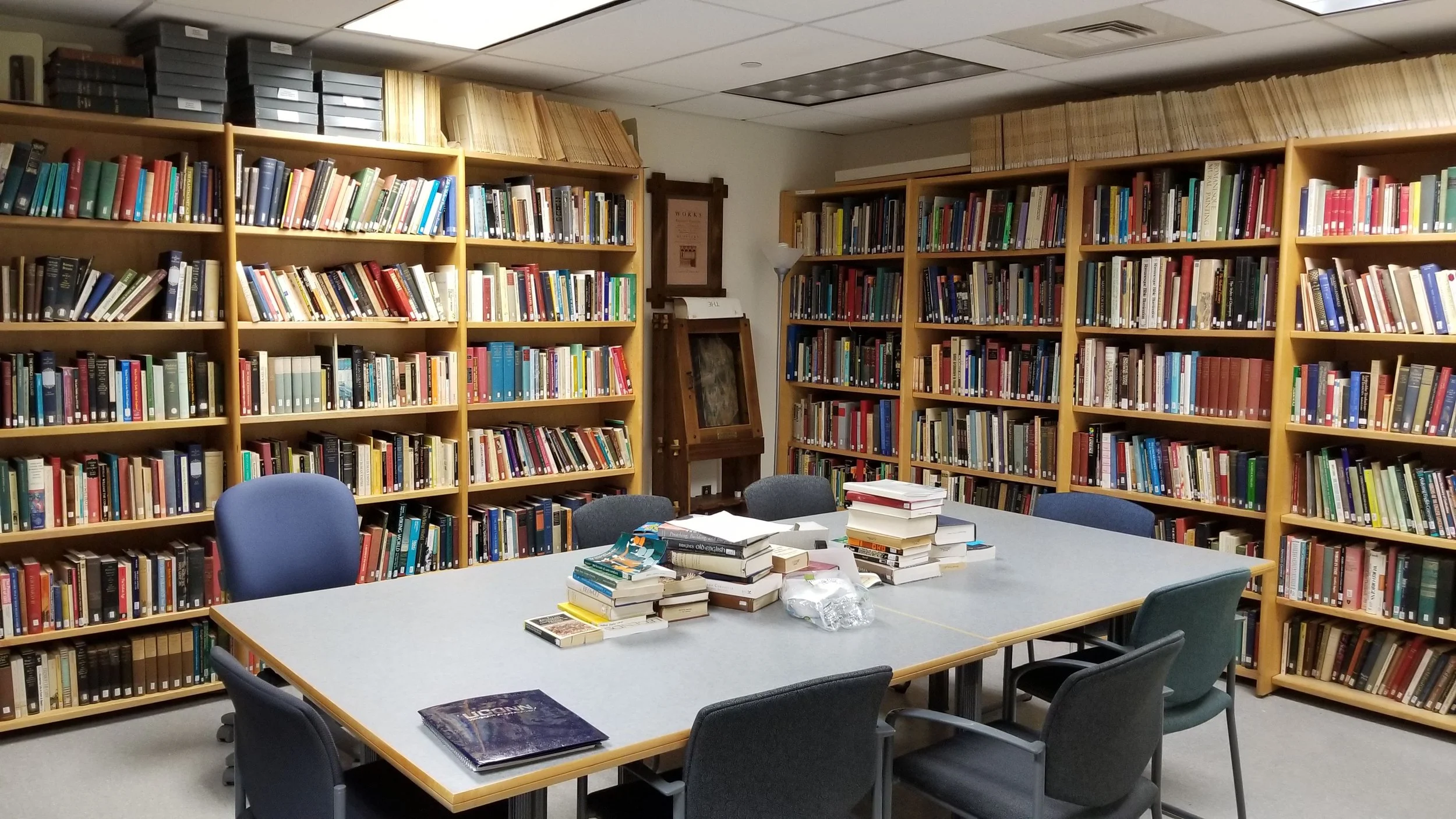
The graduate library of UCONN’s Medieval Studies program, now defunct.
At the end of 2026’s biggest summer blockbuster, Odysseus laments that his tale will only be sung, because there will be no one left who can read or write. I don’t know if Christopher Nolan intended this as a comment on the present anxiety about the future of literacy that now troubles intellectual humanists, or if it was surreptitious good fortune that he decided to work the historical loss of Linear B Greek script into a film which released at this particular moment. Whatever the thought behind it, the lament arrives in a climate of anxiety bordering on panic about the collapse of literacy along many vectors at once: the sequestration of reading full books to a subculture; a decline in comprehension; attention spans shrinking the length of text engaged with; and of course, the erosion of writing, increasingly outsourced to ChatGPT or Claude or whatever soulless autoscrivener your Word processor of choice now contains, built-in. The panic is not simply because reading and writing at a certain level have intrinsic value for their own sake but also because it is hard to imagine a world where these faculties atrophy that is not tenfold poorer – poorer intellectually, because reading and writing are species of thinking, and poorer culturally, because how can culture persist across fragmentation and incoherence. There is a very real fear that, after spending so many millennia lashing scattered logs of civilization’s raft back together into an intelligible whole, that we are about to rebuild Babel and come apart all over again.
Of course I am a deeply biased observer in all of this, as someone who studied and taught literature and composition, and remains emotionally attached to the field, if not economically. Six years ago I sat on the carpeted floor of a friend’s guest bedroom as I boarded with them after being hired last-minute to teach high school English ten days before the start of term. I looked at the syllabus I had inherited, and scrapped it. In a matter of days I had pulled two new original syllabi out of a hat, just in time to begin teaching them to my hapless students. Now, I don’t know if that was necessarily a wise thing to do, and it was certainly motivated in part by my desire to write syllabi simply because that it what I enjoy doing – but my point is that if you sat me down today and asked me to do the same, I wouldn’t have a clue how to teach those classes. Everything relied on assigning reading and writing to be done at home; the entire structure of homework was meant to stage episodes of revision and review. Now the ubiquity of AI in composition has some teachers surrendering to it with a shrug, and others throwing up a wall of blue books, like the Collector piling up furniture in a desperate attempt to shore up the mud ramparts in J.G. Farrell’s The Siege of Krishnapur. But as Michael Genovese points out (https://www.insidehighered.com/opinion/views/2026/09/17/cures-ai-are-killing-humanities-opinion), none of the responses to AI so far actually cure the disease, which is not to say that the cure is worse than the disease, but that in either scenario we are worse off than we were before – and the humanities were not doing well before.
I suppose some of this is special pleading, with a normal human helping of hypocritical self-interest; I always scorned the people who opposed automation of industry as backwards and economically illiterate, and here I am wailing about how my particular expertise (to the extent I developed it – I didn’t get that far) is already dead. And yet people must read – they must write – it is simply unthinkable that they be cut off from the beauty and meaning of thought expressed in words. And yet, the gentlemen of the 19th century who read Homer’s Odyssey in the ancient Greek it was recorded in would probably feel that I am as intellectually amputated from accessing truth and beauty as anyone growing up with AI, I who cannot fluently read anything besides English. And yet in fear and pride I find myself once again judgmental of the next generation, even while aware of my phony pretentions.
The catalyst that prompted me to post this was, as is so often the case, an article published in the Atlantic this summer – written, I should acknowledge given my admitted judgmentalism, by a person a generation younger than me. I’m referring of course to Rose Horowitch’s The End of Reading Is Here (https://www.theatlantic.com/magazine/2026/08/reading-crisis-postliterate-age/687618/?gift=jUioLBatr3tIwuTcBrggCWrQ17inIDYrdln0H9U7RMw). The article is well worth reading in full, and it catalogues a host of symptoms pointing to the dire conclusion that many, many people are losing the ability to comprehend and synthesize meaning from texts longer than a fragment. It also explains some of the possible implications of this shift for how people – and whole societies – think.
Now, who am I really to throw stones at the my neighbors’ houses; after all, I read less today than I did at twelve; I probably spend more hours scrolling Instagram reels for brainrot memes than reading a book – and I’m 36 years old and didn’t get a smartphone until my prefrontal cortex had fully developed. Still, when I read about kindergartners crying in the absence of their iPads, school administrators telling teachers to assign excerpts only and no books, or Harvard students complaining that being asked to read is a form of withholding information from them because it is too difficult, I want to throw my laptop against the wall. It’s not the kids’ fault they are born into a world that pushes them away from reading and writing and toward scrolling and prompting, though I do think people have to penultimately be responsible for themselves. Still, it’s so hard to feel so dismayed and not lash out in anger at – well, at children. And what does that say about a former teacher?
I’m not simply upset about a discipline or an industry, I’m worried about the collapse of a shared culture, of what little remains of discursive politics, of our civilization. Is the liberal, humanistic world men bled and died for at Gettysburg and Normandy to be murdered by a democracy of thoughtlessness? Even our inward thoughts are altered by the written word. Without it, or with less of it, less evenly distributed, will we even be able to relate to each other fully? And in the inner darkness I am tempted to let an ugly atavistic fear question to what extent we will retain our recognizable humanity – even though I know that even the suggestion is a wicked lie, not just because it is the same seed of pride behind years of racism and colonialism and eugenicism, behind every settled society’s bigotry against the barbarians, but also because it implicitly attributes degrees of humanity based on differences in thought – which denies the Imago Dei without which there’s no point even comparing human minds to each other, because we all pale to invisibility in the light of divine intellect. And yet, modern, Christian open-mindedness does feel harder to maintain in a world where the barbarians have returned.
How then does one carry on with hope into this brave new world, without despising the people in it, or fearing their tomorrow? Earlier I said people have to ‘penultimately’ be responsible for themselves. I started writing ‘ultimately,’ and in the middle of the word I thought better of it – the act of writing prompted the thought that I do not actually believe people are ultimately responsible for saving their own brains, or lives, or souls, for that matter. Because we all fail at that, and ultimately the responsibility is taken up by God, and we have to remember the reality of our human condition – ontological humility. It is helpful here to recall that the vast majority of humans to ever live have been illiterate, that the earliest Christians were not, in many cases, educated people – and that the same God who held the full and beautiful humanity of unlettered millions for hundreds of thousands of years, and still does today for the less fortunate but no less worthy among us, will in the end write our names in His book. The only rebuke to the temptation of both pride, driving me to condemn others, the reminder that God holds them in His love as much as I, is also the answer to fear: all the possible horrors and incoherencies of tomorrow in the debased life of the mind notwithstanding, our minds live not on words but by the impulse of the divine Mind, who will have the Final Word, and one day we shall read books and write them too, in a better world.
