Middlemarch & Me
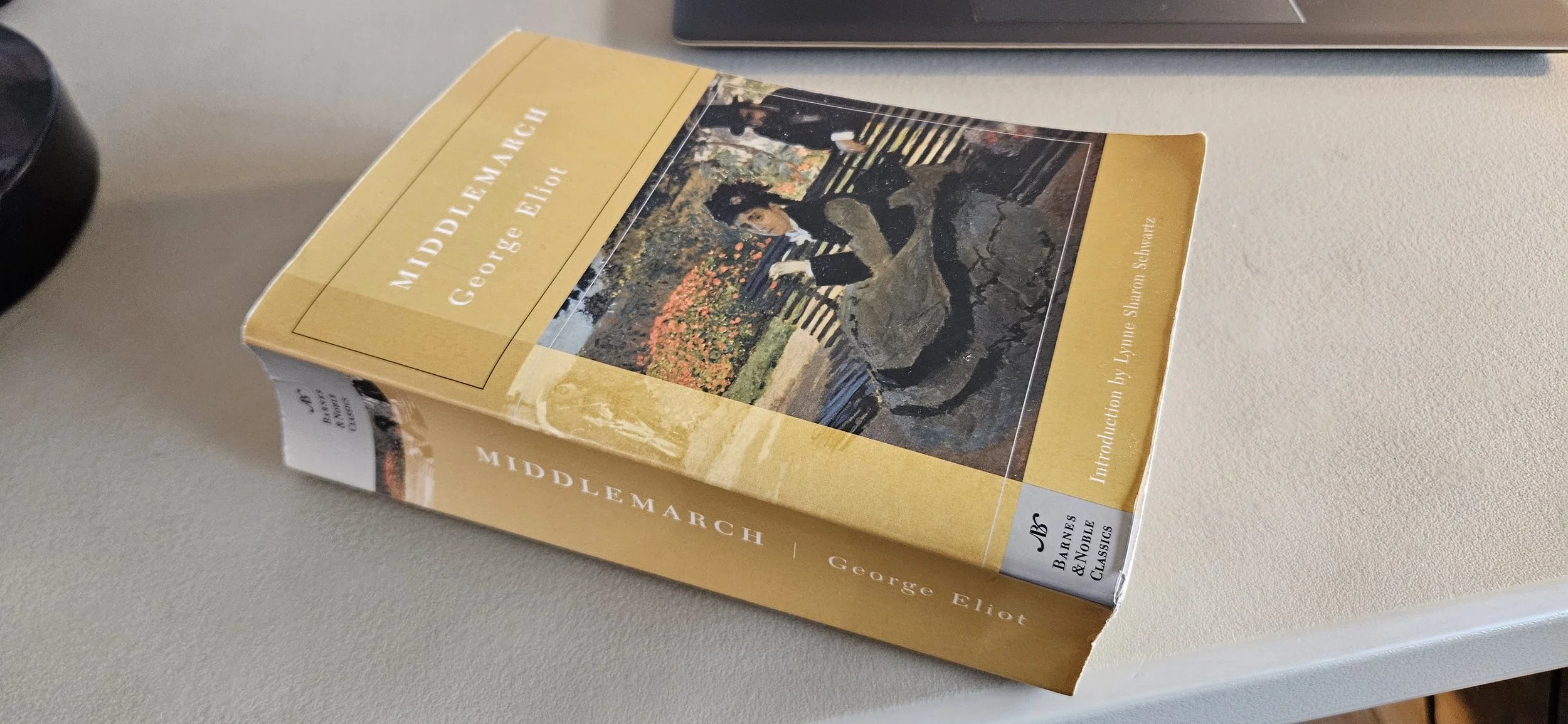
Everyone says Middlemarch is a great novel, one of the best; I certainly found it so. What I didn’t expect, though I wasn’t surprised, was to find bits of myself gazing back at me again and again, reflected off a bevy of different characters. And in all honesty, these are not the bits of myself that I wanted to see. George Eliot somehow dispels all fog, and renders the interior motives and thoughts of all of her characters as clear as a mountain stream. It is the specificity of these descriptions which arrested me, because it felt as though what I found confusing, fearful, and embarrassing in myself was being precisely taxonomized by an Observer, like I were being pinned down. I mean this in the nicest possible way – there is no trace of unkindness in Eliot’s work, and I felt no sense of hostility from the author. Nonetheless, I found myself crucified upon her characters.
To be sure, this included some of the better characters – I can relate in obvious ways to Dorothea’s scrupulosity, and perhaps everyone can relate to her mistaken judgment. But the resemblance disappears once we consider her as someone who actively lives out her scruples. And when I heard good Mary Garth say this,
“Oh, I have an easy life—by comparison. I have tried being a teacher, and I am not fit for that: my mind is too fond of wandering on its own way. I think any hardship is better than pretending to do what one is paid for, and never really doing it.”
I felt kinship with preferring my own wandering thoughts to whatever I ought to be doing for work. I fret about whether or not I have her integrity in the matter, though. And then Will Ladislaw goes about projecting his imagination of how others think about him onto them:
“Yes, suppose!” said Will Ladislaw, in a contemptuous undertone, intended to dismiss the subject. He was conscious of being irritated by ridiculously small causes, which were half of his own creation. Why was he making any fuss about Mrs. Casaubon? And yet he felt as if something had happened to him with regard to her. There are characters which are continually creating collisions and nodes for themselves in dramas which nobody is prepared to act with them. Their susceptibilities will clash against objects that remain innocently quiet.
This describes me as well as anything I’ve read.
But more than these I regrettably see glimpses of myself in the frustrated, proud dreams of Lydgate, whose mundane life seems to immure him bit by bit over the course of the narrative, but without producing the virtue of contented humility which can let go of the sense that one is meant to be great and anything less is beneath one. This frustration is all too familiar:
But he was now a prey to that worst irritation which arises not simply from annoyances, but from the second consciousness underlying those annoyances, or wasted energy and former purposes. “This is what I am thinking of; and that is what I might have been thinking of,” was the bitter incessant murmur within him, making every difficulty a double goad to impatience.
And the following line articulates quite well the experience of giving up on the dream of academia – even as it betrays a silly self-importance and a mean contempt for ordinary life and people:
Only those who know the supremacy of the intellectual life—the life which has a seed of ennobling thought and purpose within it—can understand the grief of one who falls from that serene activity into the absorbing soul-wasting struggle with worldly annoyances.
More troubling is Mr. Bulstrode, caught in the vice of God – which is how I always tended to see the vice of consequences for my own sins. Many times in my early life I felt the dread of some impending consequence or the heavy obligation to face something which terrified and shamed me, and fled, always casting looks over my shoulder. I suppose there is an extent to which I will always fixate on characters who are caught trying to wriggle out of their conscience in terror. I don’t know how much of that is how one should feel, and how much of it is a kind of scrupulosity that is unhelpful.
I certainly understand the inability to move on with life without some kind of absolution:
The spiritual kind of rescue was a genuine need with him. There may be coarse hypocrites, who consciously affect beliefs and emotions for the sake of gulling the world, but Bulstrode was not one of them. He was simply a man whose desires had been stronger than his theoretic beliefs, and who had gradually explained the gratification of his desires into satisfactory agreement with those beliefs. If this be hypocrisy, it is a process which shows itself occasionally in us all, to whatever confession we belong, and whether we believe in the future perfection of our race or in the nearest date fixed for the end of the world; whether we regard the earth as a putrefying nidus for a saved remnant, including ourselves, or have a passionate belief in the solidarity of mankind.
And the awareness of hypocrisy, of, as this says, the unwillingness to cast away the means of breaking the vow, so often precluded me from believing my own repentance, and so despairing of it:
A man vows, and yet will not cast away the means of breaking his vow. Is it that he distinctly means to break it? Not at all; but the desires which tend to break it are at work in him dimly, and make their way into his imagination, and relax his muscles in the very moments when he is telling himself over again the reasons for his vow.
And I recognize this exact sequence of thoughts and feelings shadowing my life on too many occasions, stretching back into childhood:
He had long poured out utterances of repentance. But to-day a repentance had come which was of a bitterer flavor, and a threatening Providence urged him to a kind of propitiation which was not simply a doctrinal transaction. The divine tribunal had changed its aspect for him; self prostration was no longer enough, and he must bring restitution in his hand. It was really before his God that Bulstrode was about to attempt such restitution as seemed possible: a great dread had seized his susceptible frame, and the scorching approach of shame wrought in him a new spiritual need. Night and day, while the resurgent threatening past was making a conscience within him, he was thinking by what means he could recover peace and trust—by what sacrifice he could stay the rod. His belief in these moments of dread was, that if he spontaneously did something right, God would save him from the consequences of wrong-doing. For religion can only change when the emotions which fill it are changed; and the religion of personal fear remains nearly at the level of the savage.
And ultimately the experience of conscience collapses into panic:
Strange, piteous conflict in the soul of this unhappy man, who had longed for years to be better than he was—who had taken his selfish passions into discipline and clad them in severe robes so that he had walked with them as a devout quire, till now that a terror had risen among them, and they could chant no longer, but threw out their common cries for safety.
But the character that really hangs over me in Middlemarch is Mr. Casaubon. Here is a man who has disappeared down the rabbit hole of his particular academic project, and followed the logic of it to its end, prioritizing it over the rest of life – and yet his project is fruitless, not only because he will never actually complete it, but because it is conceptually flawed – he leapt at an aesthetically appealing thesis, and worked backwards to justify that. This is my way of writing and thinking, and I also worry that all the projects I put time and thought towards and claim to care about are misconceived and will not matter – or rather, that they are a waste of time born out of mistaken self-regard.
“But Mr. Casaubon was now brooding over something through which the question of his health and life haunted his silence with a more harassing importunity even than through the autumnal unripeness of his authorship. It is true that this last might be called his central ambition; but there are some kinds of authorship in which by far the largest result is the uneasy susceptibility accumulated in the consciousness of the author—one knows of the river by a few streaks amid a long-gathered deposit of uncomfortable mud. That was the way with Mr. Casaubon’s hard intellectual labors. Their most characteristic result was not the ‘Key to all Mythologies,’ but a morbid consciousness that others did not give him the place which he had not demonstrably merited—a perpetual suspicious conjecture that the views entertained of him were not to his advantage—a melancholy absence of passion in his efforts at achievements, and a passionate resistance to the confession that he had achieved nothing.
Thus his intellectual ambition which seemed to others to have absorbed and dried him, was really no security against wounds, least of all against those which came from Dorothea.
What really worries one about Casaubon is that he knows he is wasting his time, he perceives that others do not regard him as the genius his whole concept of himself depends on, and he fears that this is true – and it is. That idea that one’s nagging self-doubt is the objective truth come to dispel a self-serving delusion is the worm that gnaws my apple.
In Mr. Casaubon’s ear, Dorothea’s voice gave loud emphatic iteration to those muffled suggestions of consciousness which it was possible to explain as mere fancy, the illusion of exaggerated sensitiveness: always when such suggestions are unmistakably repeated from without, they are resisted as cruel and unjust. We are angered even by the full acceptance of our humiliating confessions—how much more by hearing in hard distinct syllables from the lips of a near observer, those confused murmurs which we try to call morbid, and strive against as if they were the oncoming of numbness!
Eliot is sympathetic to Casaubon, but that is little comfort; is he consigned to slumber in obscure dust, apart from the elect who live for others and thus live in fruitful hope? As long as some men are like Casaubon and do not shake off their selves, but succumb to them, I in my lethargy will take the easy path of identifying with them in fear, to then ask all passers-by for reassurance that all shall regardless be well, rather than actually living well.
These were heavy impressions to struggle against, and brought that melancholy embitterment which is the consequence of all excessive claim: even his religious faith wavered with his wavering trust in his own authorship, and the consolations of the Christian hope in immortality seemed to lean on the immortality of the still unwritten Key to all Mythologies. For my part I am very sorry for him. It is an uneasy lot at best, to be what we call highly taught and yet not to enjoy: to be present at this great spectacle of life and never to be liberated from a small hungry shivering self—never to be fully possessed by the glory we behold, never to have our consciousness rapturously transformed into the vividness of a thought, the ardor of a passion, the energy of an action, but always to be scholarly and uninspired, ambitious and timid, scrupulous and dimsighted.
Instead of wondering at this result of misery in Mr. Casaubon, I think it quite ordinary. Will not a tiny speck very close to our vision blot out the glory of the world, and leave only a margin by which we see the blot? I know no speck so troublesome as self. And who, if Mr. Casaubon had chosen to expound his discontents—his suspicions that he was not any longer adored without criticism—could have denied that they were founded on good reasons? On the contrary, there was a strong reason to be added, which he had not himself taken explicitly into account—namely, that he was not unmixedly adorable. He suspected this, however, as he suspected other things, without confessing it, and like the rest of us, felt how soothing it would have been to have a companion who would never find it out.
The book ultimately is about how to live well despite the failure of one’s dreams, and about the value of that obscure life laid in the dust; my fixation on Casaubon is a feature of my own insecurity and lazy reticence to risk trying to identify with the real heroes of the story, but they are there all the same to encourage us. The noblest character by far is Mr. Farebrother, who closes the door willingly on his own dream of love in order to help his parishioner and friend, without bitterness or complaint. It is an intimidating thing to see someone with all my recognizable moral sentiments actually obey them in spite of the difficulty.
In the end, the way to live after coming to the dead end at the center of the labyrinth of the self is shown by Farebrother, and Will’s poet’s soul, which rejoices in all of life despite its circumstances, and in Dorothea most of all, who rises from her own dashed hopes to face the dawn and minister to her neighbor, without thought for herself. That remains the only real way to live. I only hope there is some mercy for those of us who might be Casaubons, committed to a worthless self-directed project.
More quotes, some of which speak further to the thoughts I have spoken above:
“Young ladies don’t understand political economy, you know,” said Mr. Brooke, smiling towards Mr. Casaubon. “I remember when we were all reading Adam Smith. There is a book, now. I took it in all the new ideas at one time—human perfectibility, now. But some say, history moves in circles; and that may be very well argued; I have argued it myself. The fact is, human reason may carry you a little too far—over the hedge, in fact. It carried me a good way at one time; but I saw it would not do. I pulled up; I pulled up in time. But not too hard. I have always been in favor of a little theory: we must have Thought; else we shall be landed back in the dark ages. But talking of books, there is Southey’s ‘Peninsular War.’ I am reading that of a morning. You know Southey?”
“…and stifled in the depths of her heart was the feeling that her sister was too religious for family comfort. Notions and scruples were like spilt needles, making one afraid of treading, or sitting down, or even eating.”
Not that this inward amazement of Dorothea’s was anything very exceptional: many souls in their young nudity are tumbled out among incongruities and left to “find their feet” among them, while their elders go about their business. Nor can I suppose that when Mrs. Casaubon is discovered in a fit of weeping six weeks after her wedding, the situation will be regarded as tragic. Some discouragement, some faintness of heart at the new real future which replaces the imaginary, is not unusual, and we do not expect people to be deeply moved by what is not unusual. That element of tragedy which lies in the very fact of frequency, has not yet wrought itself into the coarse emotion of mankind; and perhaps our frames could hardly bear much of it. If we had a keen vision and feeling of all ordinary human life, it would be like hearing the grass grow and the squirrel’s heart beat, and we should die of that roar which lies on the other side of silence. As it is, the quickest of us walk about well wadded with stupidity.
“A man must have a very rare genius to make changes of that sort. I am afraid mine would not carry me even to the pitch of doing well what has been done already, at least not so well as to make it worth while. And I should never succeed in anything by dint of drudgery. If things don’t come easily to me I never get them.”
“You seem not to care about cameos,” said Will, seating himself at some distance from her, and observing her while she closed the cases.
“No, frankly, I don’t think them a great object in life,” said Dorothea.
“I fear you are a heretic about art generally. How is that? I should have expected you to be very sensitive to the beautiful everywhere.”
“I suppose I am dull about many things,” said Dorothea, simply. “I should like to make life beautiful—I mean everybody’s life. And then all this immense expense of art, that seems somehow to lie outside life and make it no better for the world, pains one. It spoils my enjoyment of anything when I am made to think that most people are shut out from it.”
“I call that the fanaticism of sympathy,” said Will, impetuously. “You might say the same of landscape, of poetry of all refinement. If you carried it out you ought to be miserable in your own goodness, and turn evil that you might have no advantage over others. The best piety is to enjoy—when you can. You are doing the most then to save the earth’s character as an agreeable planet. And enjoyment radiates. It is of no use to try and take care of all the world; that is being taken care of when you feel delight—in art or in anything else. Would you turn all the youth of the world into a tragic chorus, wailing and moralizing over misery? I suspect that you have some false belief in the virtues of misery, and want to make your life a martyrdom.” Will had gone further than he intended, and checked himself.
“To be a poet is to have a soul so quick to discern that no shade of quality escapes it, and so quick to feel, that discernment is but a hand playing with finely-ordered variety on the chords of emotion—a soul in which knowledge passes instantaneously into feeling, and feeling flashes back as a new organ of knowledge. One may have that condition by fits only.”
“But you leave out the poems,” said Dorothea. “I think they are wanted to complete the poet. I understand what you mean about knowledge passing into feeling, for that seems to be just what I experience. But I am sure I could never produce a poem.”
“You are a poem—and that is to be the best part of a poet—what makes up the poet’s consciousness in his best moods,” said Will, showing such originality as we all share with the morning and the spring-time and other endless renewals.
But skepticism, as we know, can never be thoroughly applied, else life would come to a standstill: something we must believe in and do, and whatever that something may be called, it is virtually our own judgment, even when it seems like the most slavish reliance on another.
Caleb made no rejoinder, but presently lowered his spectacles, drew up his chair to the desk, and said, “Deuce take the bill—I wish it was at Hanover! These things are a sad interruption to business!”
The first part of this speech comprised his whole store of maledictory expression, and was uttered with a slight snarl easy to imagine. But it would be difficult to convey to those who never heard him utter the word “business,” the peculiar tone of fervid veneration, of religious regard, in which he wrapped it, as a consecrated symbol is wrapped in its gold-fringed linen.
Caleb Garth often shook his head in meditation on the value, the indispensable might of that myriad-headed, myriad-handed labor by which the social body is fed, clothed, and housed. It had laid hold of his imagination in boyhood. The echoes of the great hammer where roof or keel were a-making, the signal-shouts of the workmen, the roar of the furnace, the thunder and plash of the engine, were a sublime music to him; the felling and lading of timber, and the huge trunk vibrating star-like in the distance along the highway, the crane at work on the wharf, the piled-up produce in warehouses, the precision and variety of muscular effort wherever exact work had to be turned out,—all these sights of his youth had acted on him as poetry without the aid of the poets, had made a philosophy for him without the aid of philosophers, a religion without the aid of theology. His early ambition had been to have as effective a share as possible in this sublime labor, which was peculiarly dignified by him with the name of “business;” and though he had only been a short time under a surveyor, and had been chiefly his own teacher, he knew more of land, building, and mining than most of the special men in the country.
His classification of human employments was rather crude, and, like the categories of more celebrated men, would not be acceptable in these advanced times. He divided them into “business, politics, preaching, learning, and amusement.” He had nothing to say against the last four; but he regarded them as a reverential pagan regarded other gods than his own. In the same way, he thought very well of all ranks, but he would not himself have liked to be of any rank in which he had not such close contact with “business” as to get often honorably decorated with marks of dust and mortar, the damp of the engine, or the sweet soil of the woods and fields. Though he had never regarded himself as other than an orthodox Christian, and would argue on prevenient grace if the subject were proposed to him, I think his virtual divinities were good practical schemes, accurate work, and the faithful completion of undertakings: his prince of darkness was a slack workman. But there was no spirit of denial in Caleb, and the world seemed so wondrous to him that he was ready to accept any number of systems, like any number of firmaments, if they did not obviously interfere with the best land-drainage, solid building, correct measuring, and judicious boring (for coal). In fact, he had a reverential soul with a strong practical intelligence. But he could not manage finance; he knew values well, but he had no keenness of imagination for monetary results in the shape of profit and loss; and having ascertained this to his cost, he determined to give up all forms of his beloved “business” which required that talent. He gave himself up entirely to the many kinds of work which he could do without handling capital, and was one of those precious men within his own district whom everybody would choose to work for them, because he did his work well, charged very little, and often declined to charge at all. It is no wonder, then, that the Garths were poor, and “lived in a small way.” However, they did not mind it.
“Oh, my dear, when you have a clergyman in your family you must accommodate your tastes; I did that very early. When I married Humphrey I made up my mind to like sermons, and I set out by liking the end very much. That soon spread to the middle and the beginning, because I couldn’t have the end without them.”
“But it is very difficult to be learned; it seems as if people were worn out on the way to great thoughts, and can never enjoy them because they are too tired.”
“If we had to describe a man who is retrogressive in the most evil sense of the word—we should say, he is one who would dub himself a reformer of our constitution, while every interest for which he is immediately responsible is going to decay: a philanthropist who cannot bear one rogue to be hanged, but does not mind five honest tenants being half-starved: a man who shrieks at corruption, and keeps his farms at rack-rent: who roars himself red at rotten burroughs, and does not mind if every field on his farms has a rotten fate: a man very open-hearted to Leeds and Manchester, no doubt; he would give any number of representatives who will pay for their seats out of their own pockets: what he objects to giving, is a little return on rent-days to help a tenant to buy stock, or an outlay on repairs to keep the weather out at a tenant’s barn-door or make his house look a little less like an Irish cottier’s. But we all know the wag’s definition of a philanthropist: a man whose charity increases directly as the square of the distance.”
Any one observing him would have seen a change in his complexion, in the adjustment of his facial muscles, in the vividness of his glance, which might have made them imagine that every molecule in his body had passed the message of a magic touch. And so it had. For effective magic is transcendent nature; and who shall measure the subtlety of those touches which convey the quality of soul as well as body, and make a man’s passion for one woman differ from his passion for another as joy in the morning light over valley and river and white mountain-top differs from joy among Chinese lanterns and glass pannels? Will, too, was made of very impressible stuff. The bow of a violin drawn near him cleverly, would at one stroke change the aspect of the world for him, and his point of view shifted as easily as his mood. Dorothea’s entrance was the freshness of morning.
“But I have a belief of my own, and it comforts me.”
“What is that?” said Will, rather jealous of the belief.
“That by desiring what is perfectly good, even when we don’t quite know what it is and cannot do what we would, we are part of the divine power against evil—widening the skirts of light and making the struggle with darkness narrower.”
“That is a beautiful mysticism—it is a—”
“Please do not call it by any name,” said Dorothea, putting out her hands entreatingly. “You will say it is Persian, or something else geographical. It is my life. I have found it out, and cannot part with it. I have always been finding out my religion since I was a little girl. I used to pray so much—now I hardly ever pray. I try not to have desires merely for myself, because they may not be good for others, and I have too much already.”
“What is your religion?” said Dorothea. I mean—not what you know about religion, but the belief that helps you most?”
“To love what is good and beautiful when I see it,” said Will. “But I am a rebel: I don’t feel bound, as you do, to submit to what I don’t like.”
“But if you like what is good, that comes to the same thing,” said Dorothea smiling.
“Now you are subtle,” said Will.
“It’s a most uncommonly cramping thing, as I’ve often told Susan, to sit on horseback and look over the hedges at the wrong thing, and not be able to put your hand to it to make it right. What people do who go into politics I can’t think: it drives me almost mad to see mismanagement over only a few hundred acres.”
There was a little heap of them on the table in the bow-window—of various sorts, from Herodotus, which she was learning to read with Mr. Casaubon, to her old companion Pascal, and Keble’s “Christian Year.” But to-day she opened one after another, and could read none of them. Everything seemed dreary: the portents before the birth of Cyrus—Jewish antiquities—oh dear!—devout epigrams—the sacred chime of favorite hymns—all alike were as flat as tunes beaten on wood: even the spring flowers and the grass had a dull shiver in them under the afternoon clouds that hid the sun fitfully; even the sustaining thoughts which had become habits seemed to have in them the weariness of long future days in which she would still live with them for her sole companions.
Since Celia’s baby was born, she had had a new sense of her mental solidity and calm wisdom. It seemed clear that where there was a baby, things were right enough, and that error, in general, was a mere lack of that central poising force.
“I have always been thinking of the different ways in which Christianity is taught, and whenever I find one way that makes it a wider blessing than any other I cling to that as the truest—I mean that which takes in the most good of all kinds, and brings in the most people as sharers in it. It is surely better to pardon too much, than to condemn too much.”
But what we call our despair is often only the painful eagerness of unfed hope.
Mr. Brooke’s regrettable campaign speech reminds me of poor Joe Biden’s last debate:
“I am a close neighbor of yours, my good friends—you’ve known me on the bench a good while—I’ve always gone a good deal into public questions—machinery now, and machine-breaking—you’re many of you concerned with machinery, and I’ve been going into that lately. It won’t do, you know, breaking machines: everything must go on—trade, manufactures, commerce, interchange of staples—that kind of thing—since Adam Smith, that must go on. We must look all over the globe:—‘Observation with extensive view,’ must look everywhere, ‘from China to Peru,’ as somebody says—Johnson, I think, ‘The Rambler,’ you know. That is what I have done up to a certain point—not as far as Peru; but I’ve not always stayed at home—I saw it wouldn’t do. I’ve been in the Levant, where some of your Middlemarch goods go—and then, again, in the Baltic. The Baltic, now.”
Perhaps Will Ladislaw, having heard of that strange ban against him left by Mr. Casaubon, had felt it better that he and she should not meet again, and perhaps she was wrong to wish for a meeting that others might find many good reasons against. Still “I do wish it” came at the end of those wise reflections as naturally as a sob after holding the breath.
I wonder often if a stubbornly-held want, against what feels like conscience, is always fatally wrong. I am preoccupied by the concern that the honesty of “I do wish it” is perhaps no balm against judgment.
Even when he had fixed on what he should do, there would be the task of telling his father. But it must be admitted that the fixing, which had to come first, was the more difficult task:—what secular avocation on earth was there for a young man (whose friends could not get him an “appointment”) which was at once gentlemanly, lucrative, and to be followed without special knowledge?
He would have made, she thought, a much more suitable husband for her than she had found in Lydgate. No notion could have been falser than this, for Rosamond’s discontent in her marriage was due to the conditions of marriage itself, to its demand for self-suppression and tolerance, and not to the nature of her husband; but the easy conception of an unreal Better had a sentimental charm which diverted her ennui.
The present of a noble nature, generous in its wishes, ardent in its charity, changes the lights for us: we begin to see things again in their larger, quieter masses, and to believe that we too can be seen and judged in the wholeness of our character.
No—she adhered to her declaration that she would never be married again, and in the long valley of her life, which looked so flat and empty of waymarks, guidance would come as she walked along the road, and saw her follow-passengers by the way.
She began now to live through that yesterday morning deliberately again, forcing herself to dwell on every detail and its possible meaning. Was she alone in that scene? Was it her event only? She forced herself to think of it as bound up with another woman’s life—a woman towards whom she had set out with a longing to carry some clearness and comfort into her beclouded youth. In her first outleap of jealous indignation and disgust, when quitting the hateful room, she had flung away all the mercy with which she had undertaken that visit. She had enveloped both Will and Rosamond in her burning scorn, and it seemed to her as if Rosamond were burned out of her sight forever. But that base prompting which makes a woman more cruel to a rival than to a faithless lover, could have no strength of recurrence in Dorothea when the dominant spirit of justice within her had once overcome the tumult and had once shown her the truer measure of things. All the active thought with which she had before been representing to herself the trials of Lydgate’s lot, and this young marriage union which, like her own, seemed to have its hidden as well as evident troubles—all this vivid sympathetic experience returned to her now as a power: it asserted itself as acquired knowledge asserts itself and will not let us see as we saw in the day of our ignorance. She said to her own irremediable grief, that it should make her more helpful, instead of driving her back from effort.
And what sort of crisis might not this be in three lives whose contact with hers laid an obligation on her as if they had been suppliants bearing the sacred branch? The objects of her rescue were not to be sought out by her fancy: they were chosen for her. She yearned towards the perfect Right, that it might make a throne within her, and rule her errant will. “What should I do—how should I act now, this very day, if I could clutch my own pain, and compel it to silence, and think of those three?”
It had taken long for her to come to that question, and there was light piercing into the room. She opened her curtains, and looked out towards the bit of road that lay in view, with fields beyond, outside the entrance-gates. On the road there was a man with a bundle on his back and a woman carrying a baby; in the field she could see figures moving—perhaps the shepherd with his dog. Far off in the bending sky was the pearly light; and she felt the largeness of the world and the manifold wakings of men to labor and endurance. She was a part of that involuntary, palpitating life, and could neither look out on it from her luxurious shelter as a mere spectator, nor hide her eyes in selfish complaining.
What she would resolve to do that day did not yet seem quite clear, but something that she could achieve stirred her as with an approaching murmur which would soon gather distinctness. She took off the clothes which seemed to have some of the weariness of a hard watching in them and began to make her toilet. Presently she rang for Tantripp, who came in her dressing-gown.
“That was a wrong thing for you to say, that you would have had nothing to try for. If we had lost our own chief good, other people’s good would remain, and that is worth trying for. Some can be happy. I seemed to see that more clearly than ever, when I was the most wretched. I can hardly think how I could have borne the trouble, if that feeling had not come to me to make strength.”
Dorothea smiled, and Celia looked rather meditative. Presently she said, “I cannot think how it all came about.” Celia thought it would be pleasant to hear the story.
“I daresay not,” said Dorothea, pinching her sister’s chin. “If you knew how it came about, it would not seem wonderful to you.”
“Can’t you tell me?” said Celia, setting her arms cozily.
“No, dear, you would have to feel with me, else you would never know.”
Every limit is a beginning as well as an ending. Who can quit young lives after being long in company with them, and not desire to know what befell them in their after-years? For the fragment of a life, however typical, is not the sample of an even web: promises may not be kept, and an ardent outset may be followed by declension; latent powers may find their long-waited opportunity; a past error may urge a grand retrieval.
Her finely-touched spirit had still its fine issues, though they were not widely visible. Her full nature, like that river of which Cyrus broke the strength, spent itself in channels which had no great name on the earth. But the effect of her being on those around her was incalculably diffusive: for the growing good of the world is partly dependent on unhistoric acts; and that things are not so ill with you and me as they might have been, is half owing to the number who lived faithfully a hidden life, and rest in unvisited tombs.
