The Fourth Turning
I’m not late, it’s still July.
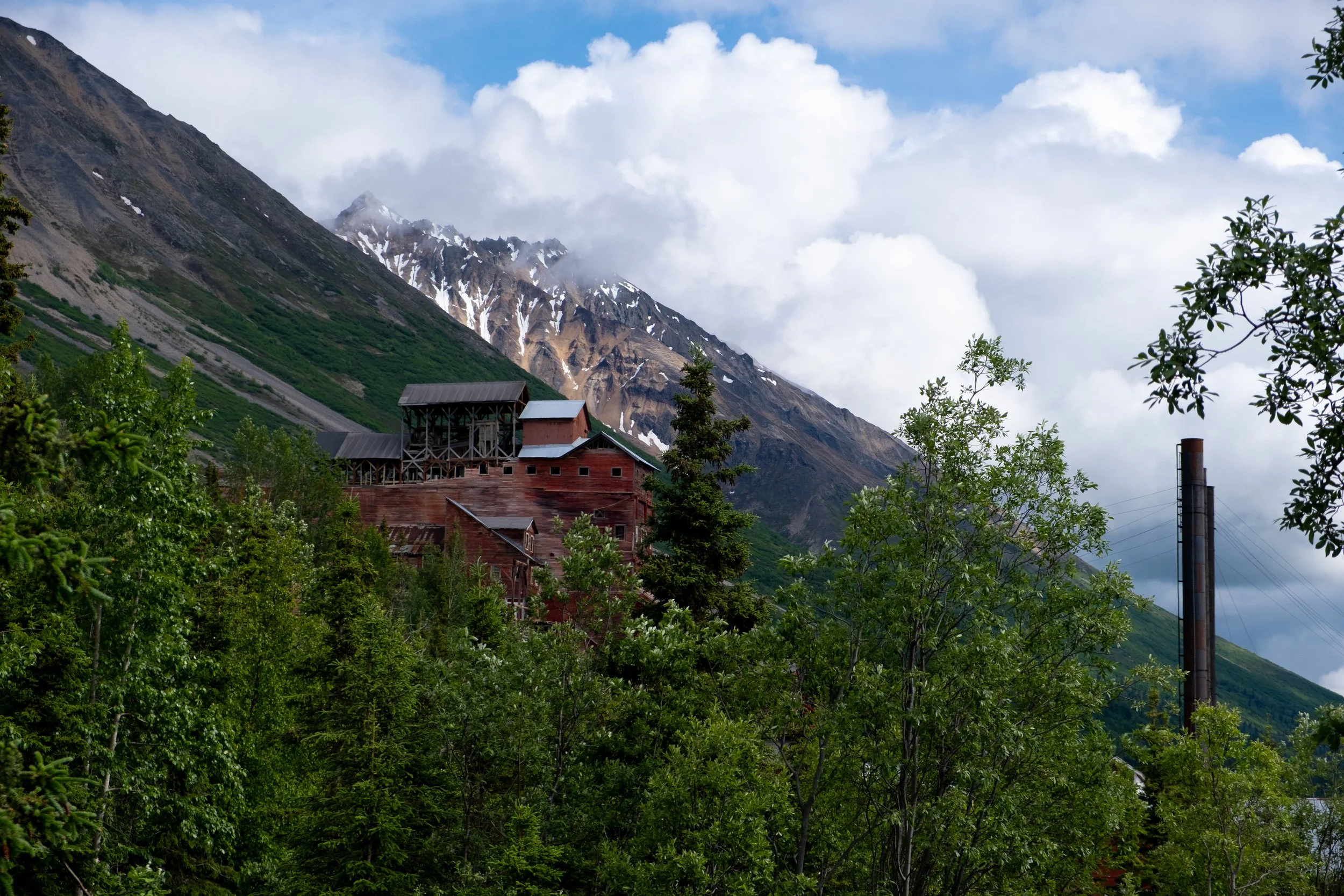
I had meant to write this on the 4th of July, alongside everyone and their (in some cases star-spangled) dog, but my parents were taking advantage of the brief Alaskan summer to visit, and I had taken the opportunity to coax them down the 60-mile gravel road to McCarthy, a town that exists as a kind of living fossil left behind by a mining operation that feels as quintessentially American as anything in our history. Prospectors crested Fourth of July Pass on the day you would expect in 1900, and spotted the green glint of copper, the electric blood of America, on the far side of a glacier so vast it appeared eternal and yet was already retreating. This coppersign is of course the same verdigris that bedecks the Statue of Liberty, and soon she would welcome hundreds of immigrants from the corners of the earth to work the Kennecott Mines, which over 29 years turned out over a billion pounds of copper. All of this was shipped out on a railway built two-hundred miles through the wilderness in three years, by hand, much of it in adverse conditions – the 8,000-foot Gilahina Trestle was built in twelve days at -60 below zero. And then in 1938, in one day, they packed everything up and left. The workers, even the management on the ground, didn’t know it was ending until it was already over.
I wonder if that will be us, someday. I certainly hope not, but when I hear about the things Americans were able to do just a hundred years ago – and in this case many of them were brand-new Americans, taking night courses for their citizenship exams after days at the mine – I am reminded less of our country today, than I am of China. Perhaps that is an overdone narrative – I certainly hope so. Still, I wonder.
What interests me about the history of the Kennecott Mine is that one can easily imagine different factions of modern Americans latching onto different aspects of it and rejecting others. Many would embrace it as an example of America welcoming immigrants come from destitution to work hard and make good; others might look at the tremendous profitability of the mine and the ability to build things at that rate as a triumph of capitalism under a more efficient regulatory regime. I suspect that those pleased by the relatively high living standards for the workers would nonetheless object to the ecological impacts of tossing the tailings and garbage down onto a glacier; and I wonder if others might resent the high pay of the immigrant workers, which outpaced what many poor Americans lived on during the contemporaneous Depression. And I worry about the burgeoning and ugly strain of “noticing” that would probably brood darkly on the ethnicity of some of the biggest investors – so far have we backslid.
This is nothing new, of course; history has always been a field of mythmaking in conflict, and there is nothing more American than relitigating our own history. Even people who largely agree politically disagree on how we should think about that – reading this review (https://www.theatlantic.com/books/2026/06/how-redefine-american-patriotism/687467/?gift=jUioLBatr3tIwuTcBrggCfswLYOpLcwDweqLu1U_Ol0&utm_source=copy-link&utm_medium=social&utm_campaign=share) of Dominic Erdozain’s new book critiquing American patriotism (which I must stipulate I have not read), I nod along at the identification of the Founding’s moral faults, only to starkly disagree with the conclusion that patriotism is damaging and that the theological impulse in American political ideology is wrong (let’s not even speak about the dismissiveness towards the Civil and Second World Wars – though in all honesty I recognize a degree to which I have built those myths as moral crusades into the foundation of much of my politics, which can be blinkering). At the same time, I ultimately agree that we should interpret the Declaration as universalistic in its claims, and not particular to the United States – but we can do that while also fully loving and embracing this country. The world is not a zero-sum pie chart, and there is no limit to the reach of the moral claims made at the founding. But then, that is me projecting my view onto the myth, just as everyone does.
It’s possible that we cannot avoid biasing the story we tell and in so doing, self-deceiving (or deceiving our children, which over time comes to the same thing). And yet we must choose stories to tell with the time we have to tell them, and that will create a particular myth. The failure to educate, the failure to narrate our history, will actually dissolve the mythic bonds surrounding the country, and we will see something akin to cell death under a microscope.

Yoni Appelbaum makes this point well in the Atlantic, which has been hoeing this row for a century and a half now - https://www.theatlantic.com/magazine/2026/07/american-history-common-narrative/687301/?gift=jUioLBatr3tIwuTcBrggCVrKWlBM9BEZnkmHKitz05Y&utm_source=copy-link&utm_medium=social&utm_campaign=share. She illustrates both the good and necessary reasons why our stable national myth began to fray – something which cannot be avoided if you attempt to hold to both timeless moral claims and present the whole and accurate truth. The problem is that we might be failing to re-spin the fibers into a stronger cord, capable of holding all those things in tension within it sans contradiction. And in our retreat as a community from the frightening effort of collective mythmaking, we have ceded ground to people who are perfectly happy to reduce America to “a particular place, a particular people,” as the Vice President so bluntly puts it. Us, and not them.
Of course America is a particular place, and the people here are particular – but neither is exclusively so, and we are not more worthy of God’s love than anyone else. This is where the question of exceptionalism comes in – whether or not America ought to be first. But this misses the point. America is circumstantially exceptional because of the influence of its history – think not of a chosen land, but of a brand which ignites a forest fire that consumes the globe. But even if that were not the case it would not change what we should do, or how we should regard ourselves. We are a particular instance of universal human rights and wrongs played out on a grand scale. Reducing patriotism to affection for the familiar denies the words of the Declaration, which really did make ideological claims that we must accept or reject, and decide what they mean. I don’t want to make an idol out of the Declaration and suggest that God tells us to hold this or that view – but with the moral sense and affection that I have from God, I choose to accept the claims as I understand them because it is a better world in which they are true. If we are going to have a shared future, then we need to remember some kind of coherent past, which is both true in its ugly ways and also good in what it spurs us toward. It is worth re-adopting the approach of historians like the late Gordon Wood (https://www.theatlantic.com/ideas/2026/06/revolutionary-gordon-wood-historian/687487/?gift=jUioLBatr3tIwuTcBrggCTRAmDYXIH0vnwHoNI3DLk0&utm_source=copy-link&utm_medium=social&utm_campaign=share).
But I am not a historian, and what I can do is not narrate the truth, but relate to what I understand about it in a particular way. And perhaps this personal sort of mythmaking will provide fodder for thought. Real historians, and academics who deal with historiography in their fields, like to engage in a form of mythmaking called periodization. They talk about the long 19th century (1789-1914) or the short 20th century (1914-1991), or throw the blanket Fin de Siècle over the decadent turn between those centuries. This is consciously choosing to impose a frame around a length of time and put a name to it – not as an objective description of the measurable past, but as a creative reaction to the received past. There is no one right or wrong answer to how one does this, as long as one recognizes that periods are not objective and not mutually exclusive – if I decide to split a century up one way, that gives a certain narrative with some truth; but it may be well worth splitting it a different way to cast some light in the shadows of the first.
We can’t really avoid periodization, actually – even our chronology of decades and centuries imposes a subjective lens. We think of the ‘90s as a cohesive and distinct thing, but naught but our calendar objectively separates them from the ‘80s or aughts. Yet our historical, our experiential (for those of us who remember the ‘90s) vocabulary would be impoverished without this concept, so we use it even as it distorts. Before the numerical calendar, historians in different countries centered the reigns of their kings as the definitive metronome of time – useful for considering the greatness of the ruler, blinkering in that it obscures the rest of the world. Japan still does this with its formal traditional calendar, despite the fact that its Emperor has actually ruled only very briefly and intermittently during the last thousand years. In that sense, the regnal eras are arbitrary; but in an example of how periodization is useful, the Showa Era (1926-1989) has become a wonderful narrative frame to capture the intense drama and rapidity of Japan’s 20th century, illustrated all the better for catching such extremes in a single lifetime.
I may be no historian, but as a tourist I can readily see that Kennecott is from another America. And yet it was operational into the lifetime of my grandparents, who passed in the last year. And that span – of a lifetime – is how I tend to think about periodization of American history. For some time now I have chosen to think about America as divided into thirds, each the length of a lifespan (perhaps a little shorter). There are interregna where the nation is in flux; and of course, one glaringly obvious objection to my scheme is that it puts us in one of these pivotal moments right now, privileging the importance of whatever we do – which is perhaps a narcissism befitting our present era. But then, that’s the role of periods – we impose them on the past as a narrative to help make sense of the present, which is always in flux and unknown; and whatever periods future historians will place us in, we cannot yet know.
The cookie crumbles thusly:
Interregnum 1: 1776-1789
I was about to type that this is self-explanatory, but then I realized that I think all of these are self-explanatory and don’t need much elaboration. For the first thirteen years since the Declaration created the country and articulated the things everyone claimed to agree on, there was crisis and transition. First the Revolution itself, an all-consuming crisis confronted by an ad-hoc Continental Congress and Army and many different militia and individuals. This period also saw a rupture between Patriots and Loyalists which was a great trauma that the country tends to forget. After the Treaty of Paris the country continued operating as a loose confederation led by a single legislature, with Washington stepping in when absolutely necessary as the closest thing to a national leader we had. There are echoes here of the unstable English Republic, wherein Parliament expelled its enemies, won its civil war, but failed to stabilize a state that could survive Cromwell’s death. The most important lesson from this is that despite the divisions in the country being elevated by the defeat of the one common enemy, Americans were able to recognize that things could not go on as they were, and form a consensus solution for a change in government.
Period 1: 1789-1860
The Republic works, but the moral compromises and contradictions baked in from the beginning, which predate the Revolution and were ultimately flaws in the people themselves which the state cannot correct, begin to work out their relentless logic. The power of the Declaration’s universal moral claims is proven by the way in which the hypocrisy of slavery is undeniable and inescapable, and attempts to increase the institution’s power are seen as morally existential by the heirs of the Puritans. In turn, the enslavers feel their own existential dread not simply from the shift in public opinion, but also from economic progress and change, immigration in the North, and their awareness of their own hypocrisy. But there is plenty of that to go around, as the country enthusiastically and aggressively expands west and south, where enterprising self-made pioneering is mixed with, or in cases indistinguishable from, avaricious squatting. I have personally never been able to resolve or tease out my idea of how things should have gone differently, and given that this is a world in which life and death are interdependent, I think that recognizing that good and evil coexisted at times in the same acts and changes, or that God brought good from evil, is the best we can hope for. During the same period the country develops its historic population core, everything from the east coast to the river, which is still visible from space as a dense cluster of lights, all close together. And, crucially, the country developed a highly-literate and politically-engaged population, with a strong sense of national identity. But as the awareness of the population grew, inevitably the logic of the contradiction between slavery’s tension with the values of the Declaration and its entrenched political power produced a breaking point.
Interregnum 2: 1860-1865
The Civil War needs no explanation as a hinge, the second turning of the Republic. Not only does it clarify and enforce (incompletely) the universal values of the Founding, it also resolves the power relations between the different levels of government, and increases the power of the President. But it also marks a turning point as it sees the country knit together by rail and wire, the real beginning of the age in which rapid travel over long distance is affordable, which shifts the physical nature of the country. And, having resolved the contradiction of slavery through the power of the Federal government, that now becomes the single position which must be controlled in any fundamental conflict. But that fundamental conflict of contradictory ideas does not emerge yet, instead giving way to a long period of consensus created by growth, and then one of consensus created by external threat.
Period 2: 1865-1932
This is one of the most interesting periods of American history, and one which is more a time of rapid and sustained change than a stable state – though the state itself is, at the top, quite static. Society, technology, and the economy all change dramatically. The question of women’s full citizenship, a cause which had developed in company with, but to some degree in the shadow of the abolitionist movement, is resolved not through a single rupture of conflict but through the persistent insistence of those applying the logic of the newly-clarified American ideology of freedom until it tips over into consensus. The economy grows by leaps and bounds, and amid all this growth violence flourishes between labor and management, as the issue of economic justice becomes the central division – one which has no simple answer, as slavery did. The clarity of slavery as an issue perhaps made war inevitable as the solution, because it really was all-or-nothing; the confusion and intrinsic contingency of economic justice create a continuous directional conflict with no climax. But the temperature does rise, mitigated by the general increase in wealth. The operational contradictions and corruptions of the state are reformed piecemeal. The closing of the Frontier, the fevers of aimless nationalism and scientific systematization (and stratification) of the world and time lead the country into imperialistic and internationalistic ventures which are foolhardy dead-ends. Both in those conquests and domestically, cultures are deliberately and systematically smothered by a popular authoritarian majority. Ultimately the country reveals that it can tolerate all these moral contradictions without batting an eye, but it cannot tolerate economic decline – and everything ends abruptly when the Depression creates in the population a wide consensus for a major revision in government.
Interregnum 3: 1932-1945
The Roosevelt administration, whether one credits it with success or views it as a rider upon the tides of history, presides over the third turning of American history. The country is forced to face the reality of economic deprivation, which had hitherto been successfully marginalized (which is not to say that it did not come down with its full weight on those impacted, but that there was enough growth to keep them at the margins of power). Then, the nation undergoes World War II, America’s Iliad, and these two things taken together create a new bureaucratic state more powerful than any prior empire, with a country re-fused into a shared identity and with a new relationship to the world. 1945 marks the dawn of the apocalyptic state, where prudence in leadership carries the stakes of nuclear war.
Period 3: 1945-2016?
This is America as I learned it, growing up. I realize this framing minimizes the revolutions of the 1960s or the dislocations of the 1970s, or the end of the Cold War. But I think the Civil Rights movement and the other social changes in the ‘60s were themselves a kind of working out of the logic of the new shared American identity, and its hypocritical oversights. The seeds sown in the 1970s would bear poisonous fruit, but slowly and over many decades. And the end of the Cold War marks a turning in world history, but not so much in America – instead, it is a kind of exhalation. America relaxes into absorbing (so we thought) the whole world, friends and enemies alike, into one system of neoliberal democratic capitalism. There was a broad bipartisan consensus; there were significant external enemies; and there was enough sense of progress that optimism could flourish. But this also created a kind of nihilistic cynicism, an ennui. And, importantly, this is the perspective of someone who is very, very middle class. Increasing partisanship, scientifically managed, and increasing communications in a fragmented ecosystem of self-reinforcing loops created a political situation in which the state was unable to effectively achieve consensus to make reforms; it grew increasingly sclerotic, dragging down the productive capacity of society with it. The inability of any victorious party to really fix anything material, the fixation on cultural conflicts, and most of all, the accelerant of the internet and echo chambers drove a large part of the electorate insane, engaging them in the political system without successfully creating an elite consensus to manage this constructively. Instead, even though things were on paper going relatively well, in 2016 the ossified political system enabled a minority of Americans to vote to blow everything up, whether they knew they were doing that or not.
So here we are, the Fourth Turning of the Republic. We don’t know what its end will be. The contradictions of the First Republic were moral and concrete, and they eventually forced a violent settlement. The contradictions of the Second Republic were largely economic and were resolved only by a collapse (the same may well happen to us soon with the national debt). The contradictions of the Third Republic were in the people themselves, and in their fractured and delusional worldviews. It was less an information age and more an information apocalypse. I think this is important, because it reminds us that as much as we need systemic change and economic change, we cannot resolve our present crisis without resolving the crisis of character and belief in the voters themselves.
I don’t know where we are going next, or when the next Republic will start. It feels as though we are in an inflection point; but then again, perhaps things will stabilize and muddle on, as they did after the 1960s. I hope we can achieve some kind of reckoning that addresses what we have done and creates a shared foundation on which to move forward, but it is difficult to see what that might look like.
As this new age struggles to be born, I return again and again to the same poem, written by W.B. Yeats in 1919, which for Europe was just such a historical hinge amid death, fear, and confusion. In The Second Coming, he writes:
Turning and turning in the widening gyre
The falcon cannot hear the falconer;
Things fall apart; the centre cannot hold;
Mere anarchy is loosed upon the world,
The blood-dimmed tide is loosed, and everywhere
The ceremony of innocence is drowned;
The best lack all conviction, while the worst
Are full of passionate intensity.
Surely some revelation is at hand;
Surely the Second Coming is at hand.
The Second Coming! Hardly are those words out
When a vast image out of Spiritus Mundi
Troubles my sight: somewhere in sands of the desert
A shape with lion body and the head of a man,
A gaze blank and pitiless as the sun,
Is moving its slow thighs, while all about it
Reel shadows of the indignant desert birds.
The darkness drops again; but now I know
That twenty centuries of stony sleep
Were vexed to nightmare by a rocking cradle,
And what rough beast, its hour come round at last,
Slouches towards Bethlehem to be born?
