Archive
- October 2026
- September 2026
- August 2026
- July 2026
- May 2026
- April 2026
- March 2026
- February 2026
- January 2026
- November 2025
- October 2025
- September 2025
- August 2025
- July 2025
- June 2025
- May 2025
- April 2025
- March 2025
- February 2025
- January 2025
- December 2024
- November 2024
- October 2024
- August 2024
- July 2024
- June 2024
- April 2024
- March 2024
- February 2024
- January 2024
- December 2023
- November 2023
- October 2023
- September 2023
- August 2023
- April 2023
- March 2023
- January 2023
- September 2022
- August 2022
- April 2021
- March 2021
- February 2021
- January 2021
- December 2020
Music in January 2026
Here’s my January 2026 playlist:
· I really appreciate this version of How Firm A Foundation, which I encountered on the soundtrack to the excellent 2020 adaptation of Emma, which no one seems to have really talked about because of the pandemic.
· ROSALIA’s melodramatic 2025 album Lux is kind of impossible to ignore even for someone totally unfamiliar with that oeuvre like me.
· Anywhere is a new song that feels beamed out of middle school.
· I don’t actually know what Elderberry Wine tastes like, and I don’t like champagne, but I do like this song.
· I Want You (Fever) is another ‘90s-nostalgia earworm that suggests that, artistically, the kids are all right.
· I don’t understand Emperor X’s Freeway in Heaven – as someone who makes money marketing highway engineering, I would hope that we would all be spending as much time as possible on the freeway in heaven. But this is a gorgeous, strange little song.
· The Beginning is a typically manic and upbeat track that ends Magdalena Bay’s album Mercurial World, which is great fun.
· Dance The Pain Away is a sort of battle anthem for theater kids.
· Take Me To Beijing introduced me to Chinese American Bear, a goofy, warm, and syrupy band that slots right into the growing popularity of Mandarin-English bilingual cultural products
· The Boss turned out a topical protest ballad practically overnight in January, which now serves as a good reminder of the crimes of the current administration, which pile up so fast that it’s easy to forget what they were up to just a few months ago.
· The All Time High has long been one of my favorite examples of Team Me’s exuberant sound.
· Mahashmashana is grandiose and stunning even by the standards of Father John Misty, and it earns its nine-minute runtime.
· How Could I Have Known is an achingly lovely reminiscence from Big Thief.
· Both Vashti Bunyan and Linda Perhacs achieve a kind of implausibly reedy filigree of sound, each in their own way.
· The Grey Funnel Line combines two of my favorite things: maritime folk revival & melancholy music.
· I keep putting The Beths in these playlists, but I just can’t stop. Mosquitoes gets right under my skin, to the point where I start singing along like it’s a cathartic auto-eulogy, a letting go.
· All the remaining songs are, likewise, just different ways of saying goodbye.
Sam Neill, 1947-2026

It’s been a little more than a month since Sam Neill died, and I meant to post a short note expressing my deep fondness for his career much sooner, but I put it off because I have not yet had a chance to see The Piano, which has just gotten a new 4K transfer and re-release. I was waiting for the chance to see it in theaters, but predictably it does not seem to be making its way to Alaska, so while I am confident the new transfer means it is coming to one of the plethora of streaming services, I have given up waiting for it.
I don’t really write about celebrities, but Sam Neill always had a very specific a strange presence that made his presence in a film automatically compelling, to me at least, and so for a number of years he was always one of “my guys” – the actors who I am always elated to see show up, in however small a part. I was also quite fond of his many Instagram posts from his New Zealand winery, where he carried on an extremely Hobbit-like existence during his last years. Here’s some highlights of old Sam.
He was most famous for Jurassic Park, of course: https://www.youtube.com/watch?v=E8WaFvwtphY
As a young and severe-featured man, he is wonderful in My Brilliant Career (spoilers for the movie): https://www.youtube.com/watch?v=K7paJkdRUl0
Many people have enjoyed his scenery-chewing work as the warped Dr. Weir in Event Horizon: https://www.youtube.com/watch?v=rAchA32z2zM
I love his beautifully articulation of his American dream in The Hunt for Red October: https://www.youtube.com/watch?v=P8JW75Lv25k
He astonishes, even in support of a greater performance, in the extremely disturbing Possession: https://www.youtube.com/watch?v=aLXW-oVbTxE
And of course, perhaps his finest work - In the Mouth of Madness, a tour de force (spoilers for the end of the movie): https://www.youtube.com/watch?v=6Xx6elsNg-Y
Music in 2025
Finally, my 2025 playlist, which I managed to get to under five hours this time.
Middlemarch & Me
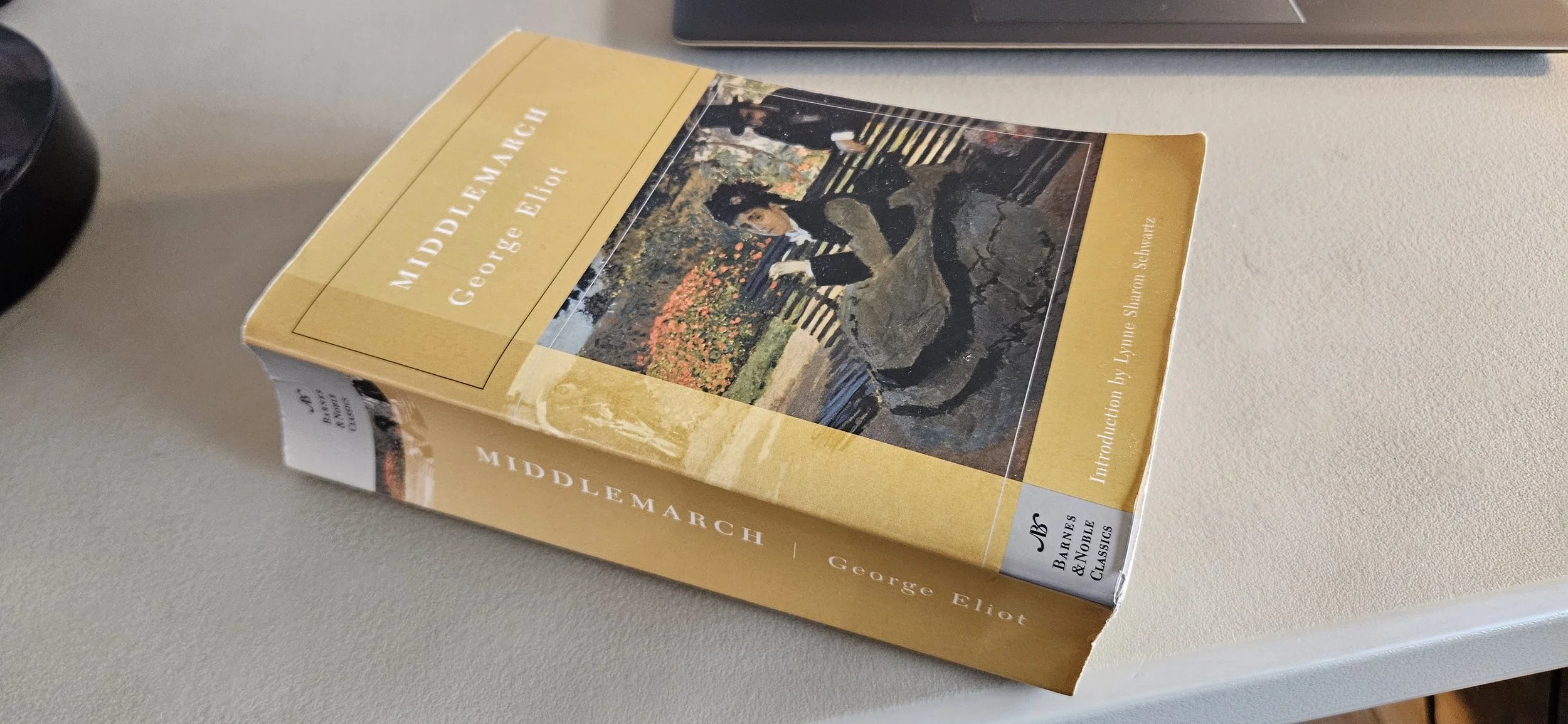
Everyone says Middlemarch is a great novel, one of the best; I certainly found it so. What I didn’t expect, though I wasn’t surprised, was to find bits of myself gazing back at me again and again, reflected off a bevy of different characters. And in all honesty, these are not the bits of myself that I wanted to see. George Eliot somehow dispels all fog, and renders the interior motives and thoughts of all of her characters as clear as a mountain stream. It is the specificity of these descriptions which arrested me, because it felt as though what I found confusing, fearful, and embarrassing in myself was being precisely taxonomized by an Observer, like I were being pinned down. I mean this in the nicest possible way – there is no trace of unkindness in Eliot’s work, and I felt no sense of hostility from the author. Nonetheless, I found myself crucified upon her characters.
To be sure, this included some of the better characters – I can relate in obvious ways to Dorothea’s scrupulosity, and perhaps everyone can relate to her mistaken judgment. But the resemblance disappears once we consider her as someone who actively lives out her scruples. And when I heard good Mary Garth say this,
“Oh, I have an easy life—by comparison. I have tried being a teacher, and I am not fit for that: my mind is too fond of wandering on its own way. I think any hardship is better than pretending to do what one is paid for, and never really doing it.”
I felt kinship with preferring my own wandering thoughts to whatever I ought to be doing for work. I fret about whether or not I have her integrity in the matter, though. And then Will Ladislaw goes about projecting his imagination of how others think about him onto them:
“Yes, suppose!” said Will Ladislaw, in a contemptuous undertone, intended to dismiss the subject. He was conscious of being irritated by ridiculously small causes, which were half of his own creation. Why was he making any fuss about Mrs. Casaubon? And yet he felt as if something had happened to him with regard to her. There are characters which are continually creating collisions and nodes for themselves in dramas which nobody is prepared to act with them. Their susceptibilities will clash against objects that remain innocently quiet.
This describes me as well as anything I’ve read.
But more than these I regrettably see glimpses of myself in the frustrated, proud dreams of Lydgate, whose mundane life seems to immure him bit by bit over the course of the narrative, but without producing the virtue of contented humility which can let go of the sense that one is meant to be great and anything less is beneath one. This frustration is all too familiar:
But he was now a prey to that worst irritation which arises not simply from annoyances, but from the second consciousness underlying those annoyances, or wasted energy and former purposes. “This is what I am thinking of; and that is what I might have been thinking of,” was the bitter incessant murmur within him, making every difficulty a double goad to impatience.
And the following line articulates quite well the experience of giving up on the dream of academia – even as it betrays a silly self-importance and a mean contempt for ordinary life and people:
Only those who know the supremacy of the intellectual life—the life which has a seed of ennobling thought and purpose within it—can understand the grief of one who falls from that serene activity into the absorbing soul-wasting struggle with worldly annoyances.
More troubling is Mr. Bulstrode, caught in the vice of God – which is how I always tended to see the vice of consequences for my own sins. Many times in my early life I felt the dread of some impending consequence or the heavy obligation to face something which terrified and shamed me, and fled, always casting looks over my shoulder. I suppose there is an extent to which I will always fixate on characters who are caught trying to wriggle out of their conscience in terror. I don’t know how much of that is how one should feel, and how much of it is a kind of scrupulosity that is unhelpful.
I certainly understand the inability to move on with life without some kind of absolution:
The spiritual kind of rescue was a genuine need with him. There may be coarse hypocrites, who consciously affect beliefs and emotions for the sake of gulling the world, but Bulstrode was not one of them. He was simply a man whose desires had been stronger than his theoretic beliefs, and who had gradually explained the gratification of his desires into satisfactory agreement with those beliefs. If this be hypocrisy, it is a process which shows itself occasionally in us all, to whatever confession we belong, and whether we believe in the future perfection of our race or in the nearest date fixed for the end of the world; whether we regard the earth as a putrefying nidus for a saved remnant, including ourselves, or have a passionate belief in the solidarity of mankind.
And the awareness of hypocrisy, of, as this says, the unwillingness to cast away the means of breaking the vow, so often precluded me from believing my own repentance, and so despairing of it:
A man vows, and yet will not cast away the means of breaking his vow. Is it that he distinctly means to break it? Not at all; but the desires which tend to break it are at work in him dimly, and make their way into his imagination, and relax his muscles in the very moments when he is telling himself over again the reasons for his vow.
And I recognize this exact sequence of thoughts and feelings shadowing my life on too many occasions, stretching back into childhood:
He had long poured out utterances of repentance. But to-day a repentance had come which was of a bitterer flavor, and a threatening Providence urged him to a kind of propitiation which was not simply a doctrinal transaction. The divine tribunal had changed its aspect for him; self prostration was no longer enough, and he must bring restitution in his hand. It was really before his God that Bulstrode was about to attempt such restitution as seemed possible: a great dread had seized his susceptible frame, and the scorching approach of shame wrought in him a new spiritual need. Night and day, while the resurgent threatening past was making a conscience within him, he was thinking by what means he could recover peace and trust—by what sacrifice he could stay the rod. His belief in these moments of dread was, that if he spontaneously did something right, God would save him from the consequences of wrong-doing. For religion can only change when the emotions which fill it are changed; and the religion of personal fear remains nearly at the level of the savage.
And ultimately the experience of conscience collapses into panic:
Strange, piteous conflict in the soul of this unhappy man, who had longed for years to be better than he was—who had taken his selfish passions into discipline and clad them in severe robes so that he had walked with them as a devout quire, till now that a terror had risen among them, and they could chant no longer, but threw out their common cries for safety.
But the character that really hangs over me in Middlemarch is Mr. Casaubon. Here is a man who has disappeared down the rabbit hole of his particular academic project, and followed the logic of it to its end, prioritizing it over the rest of life – and yet his project is fruitless, not only because he will never actually complete it, but because it is conceptually flawed – he leapt at an aesthetically appealing thesis, and worked backwards to justify that. This is my way of writing and thinking, and I also worry that all the projects I put time and thought towards and claim to care about are misconceived and will not matter – or rather, that they are a waste of time born out of mistaken self-regard.
“But Mr. Casaubon was now brooding over something through which the question of his health and life haunted his silence with a more harassing importunity even than through the autumnal unripeness of his authorship. It is true that this last might be called his central ambition; but there are some kinds of authorship in which by far the largest result is the uneasy susceptibility accumulated in the consciousness of the author—one knows of the river by a few streaks amid a long-gathered deposit of uncomfortable mud. That was the way with Mr. Casaubon’s hard intellectual labors. Their most characteristic result was not the ‘Key to all Mythologies,’ but a morbid consciousness that others did not give him the place which he had not demonstrably merited—a perpetual suspicious conjecture that the views entertained of him were not to his advantage—a melancholy absence of passion in his efforts at achievements, and a passionate resistance to the confession that he had achieved nothing.
Thus his intellectual ambition which seemed to others to have absorbed and dried him, was really no security against wounds, least of all against those which came from Dorothea.
What really worries one about Casaubon is that he knows he is wasting his time, he perceives that others do not regard him as the genius his whole concept of himself depends on, and he fears that this is true – and it is. That idea that one’s nagging self-doubt is the objective truth come to dispel a self-serving delusion is the worm that gnaws my apple.
In Mr. Casaubon’s ear, Dorothea’s voice gave loud emphatic iteration to those muffled suggestions of consciousness which it was possible to explain as mere fancy, the illusion of exaggerated sensitiveness: always when such suggestions are unmistakably repeated from without, they are resisted as cruel and unjust. We are angered even by the full acceptance of our humiliating confessions—how much more by hearing in hard distinct syllables from the lips of a near observer, those confused murmurs which we try to call morbid, and strive against as if they were the oncoming of numbness!
Eliot is sympathetic to Casaubon, but that is little comfort; is he consigned to slumber in obscure dust, apart from the elect who live for others and thus live in fruitful hope? As long as some men are like Casaubon and do not shake off their selves, but succumb to them, I in my lethargy will take the easy path of identifying with them in fear, to then ask all passers-by for reassurance that all shall regardless be well, rather than actually living well.
These were heavy impressions to struggle against, and brought that melancholy embitterment which is the consequence of all excessive claim: even his religious faith wavered with his wavering trust in his own authorship, and the consolations of the Christian hope in immortality seemed to lean on the immortality of the still unwritten Key to all Mythologies. For my part I am very sorry for him. It is an uneasy lot at best, to be what we call highly taught and yet not to enjoy: to be present at this great spectacle of life and never to be liberated from a small hungry shivering self—never to be fully possessed by the glory we behold, never to have our consciousness rapturously transformed into the vividness of a thought, the ardor of a passion, the energy of an action, but always to be scholarly and uninspired, ambitious and timid, scrupulous and dimsighted.
Instead of wondering at this result of misery in Mr. Casaubon, I think it quite ordinary. Will not a tiny speck very close to our vision blot out the glory of the world, and leave only a margin by which we see the blot? I know no speck so troublesome as self. And who, if Mr. Casaubon had chosen to expound his discontents—his suspicions that he was not any longer adored without criticism—could have denied that they were founded on good reasons? On the contrary, there was a strong reason to be added, which he had not himself taken explicitly into account—namely, that he was not unmixedly adorable. He suspected this, however, as he suspected other things, without confessing it, and like the rest of us, felt how soothing it would have been to have a companion who would never find it out.
The book ultimately is about how to live well despite the failure of one’s dreams, and about the value of that obscure life laid in the dust; my fixation on Casaubon is a feature of my own insecurity and lazy reticence to risk trying to identify with the real heroes of the story, but they are there all the same to encourage us. The noblest character by far is Mr. Farebrother, who closes the door willingly on his own dream of love in order to help his parishioner and friend, without bitterness or complaint. It is an intimidating thing to see someone with all my recognizable moral sentiments actually obey them in spite of the difficulty.
In the end, the way to live after coming to the dead end at the center of the labyrinth of the self is shown by Farebrother, and Will’s poet’s soul, which rejoices in all of life despite its circumstances, and in Dorothea most of all, who rises from her own dashed hopes to face the dawn and minister to her neighbor, without thought for herself. That remains the only real way to live. I only hope there is some mercy for those of us who might be Casaubons, committed to a worthless self-directed project.
More quotes, some of which speak further to the thoughts I have spoken above:
“Young ladies don’t understand political economy, you know,” said Mr. Brooke, smiling towards Mr. Casaubon. “I remember when we were all reading Adam Smith. There is a book, now. I took it in all the new ideas at one time—human perfectibility, now. But some say, history moves in circles; and that may be very well argued; I have argued it myself. The fact is, human reason may carry you a little too far—over the hedge, in fact. It carried me a good way at one time; but I saw it would not do. I pulled up; I pulled up in time. But not too hard. I have always been in favor of a little theory: we must have Thought; else we shall be landed back in the dark ages. But talking of books, there is Southey’s ‘Peninsular War.’ I am reading that of a morning. You know Southey?”
“…and stifled in the depths of her heart was the feeling that her sister was too religious for family comfort. Notions and scruples were like spilt needles, making one afraid of treading, or sitting down, or even eating.”
Not that this inward amazement of Dorothea’s was anything very exceptional: many souls in their young nudity are tumbled out among incongruities and left to “find their feet” among them, while their elders go about their business. Nor can I suppose that when Mrs. Casaubon is discovered in a fit of weeping six weeks after her wedding, the situation will be regarded as tragic. Some discouragement, some faintness of heart at the new real future which replaces the imaginary, is not unusual, and we do not expect people to be deeply moved by what is not unusual. That element of tragedy which lies in the very fact of frequency, has not yet wrought itself into the coarse emotion of mankind; and perhaps our frames could hardly bear much of it. If we had a keen vision and feeling of all ordinary human life, it would be like hearing the grass grow and the squirrel’s heart beat, and we should die of that roar which lies on the other side of silence. As it is, the quickest of us walk about well wadded with stupidity.
“A man must have a very rare genius to make changes of that sort. I am afraid mine would not carry me even to the pitch of doing well what has been done already, at least not so well as to make it worth while. And I should never succeed in anything by dint of drudgery. If things don’t come easily to me I never get them.”
“You seem not to care about cameos,” said Will, seating himself at some distance from her, and observing her while she closed the cases.
“No, frankly, I don’t think them a great object in life,” said Dorothea.
“I fear you are a heretic about art generally. How is that? I should have expected you to be very sensitive to the beautiful everywhere.”
“I suppose I am dull about many things,” said Dorothea, simply. “I should like to make life beautiful—I mean everybody’s life. And then all this immense expense of art, that seems somehow to lie outside life and make it no better for the world, pains one. It spoils my enjoyment of anything when I am made to think that most people are shut out from it.”
“I call that the fanaticism of sympathy,” said Will, impetuously. “You might say the same of landscape, of poetry of all refinement. If you carried it out you ought to be miserable in your own goodness, and turn evil that you might have no advantage over others. The best piety is to enjoy—when you can. You are doing the most then to save the earth’s character as an agreeable planet. And enjoyment radiates. It is of no use to try and take care of all the world; that is being taken care of when you feel delight—in art or in anything else. Would you turn all the youth of the world into a tragic chorus, wailing and moralizing over misery? I suspect that you have some false belief in the virtues of misery, and want to make your life a martyrdom.” Will had gone further than he intended, and checked himself.
“To be a poet is to have a soul so quick to discern that no shade of quality escapes it, and so quick to feel, that discernment is but a hand playing with finely-ordered variety on the chords of emotion—a soul in which knowledge passes instantaneously into feeling, and feeling flashes back as a new organ of knowledge. One may have that condition by fits only.”
“But you leave out the poems,” said Dorothea. “I think they are wanted to complete the poet. I understand what you mean about knowledge passing into feeling, for that seems to be just what I experience. But I am sure I could never produce a poem.”
“You are a poem—and that is to be the best part of a poet—what makes up the poet’s consciousness in his best moods,” said Will, showing such originality as we all share with the morning and the spring-time and other endless renewals.
But skepticism, as we know, can never be thoroughly applied, else life would come to a standstill: something we must believe in and do, and whatever that something may be called, it is virtually our own judgment, even when it seems like the most slavish reliance on another.
Caleb made no rejoinder, but presently lowered his spectacles, drew up his chair to the desk, and said, “Deuce take the bill—I wish it was at Hanover! These things are a sad interruption to business!”
The first part of this speech comprised his whole store of maledictory expression, and was uttered with a slight snarl easy to imagine. But it would be difficult to convey to those who never heard him utter the word “business,” the peculiar tone of fervid veneration, of religious regard, in which he wrapped it, as a consecrated symbol is wrapped in its gold-fringed linen.
Caleb Garth often shook his head in meditation on the value, the indispensable might of that myriad-headed, myriad-handed labor by which the social body is fed, clothed, and housed. It had laid hold of his imagination in boyhood. The echoes of the great hammer where roof or keel were a-making, the signal-shouts of the workmen, the roar of the furnace, the thunder and plash of the engine, were a sublime music to him; the felling and lading of timber, and the huge trunk vibrating star-like in the distance along the highway, the crane at work on the wharf, the piled-up produce in warehouses, the precision and variety of muscular effort wherever exact work had to be turned out,—all these sights of his youth had acted on him as poetry without the aid of the poets, had made a philosophy for him without the aid of philosophers, a religion without the aid of theology. His early ambition had been to have as effective a share as possible in this sublime labor, which was peculiarly dignified by him with the name of “business;” and though he had only been a short time under a surveyor, and had been chiefly his own teacher, he knew more of land, building, and mining than most of the special men in the country.
His classification of human employments was rather crude, and, like the categories of more celebrated men, would not be acceptable in these advanced times. He divided them into “business, politics, preaching, learning, and amusement.” He had nothing to say against the last four; but he regarded them as a reverential pagan regarded other gods than his own. In the same way, he thought very well of all ranks, but he would not himself have liked to be of any rank in which he had not such close contact with “business” as to get often honorably decorated with marks of dust and mortar, the damp of the engine, or the sweet soil of the woods and fields. Though he had never regarded himself as other than an orthodox Christian, and would argue on prevenient grace if the subject were proposed to him, I think his virtual divinities were good practical schemes, accurate work, and the faithful completion of undertakings: his prince of darkness was a slack workman. But there was no spirit of denial in Caleb, and the world seemed so wondrous to him that he was ready to accept any number of systems, like any number of firmaments, if they did not obviously interfere with the best land-drainage, solid building, correct measuring, and judicious boring (for coal). In fact, he had a reverential soul with a strong practical intelligence. But he could not manage finance; he knew values well, but he had no keenness of imagination for monetary results in the shape of profit and loss; and having ascertained this to his cost, he determined to give up all forms of his beloved “business” which required that talent. He gave himself up entirely to the many kinds of work which he could do without handling capital, and was one of those precious men within his own district whom everybody would choose to work for them, because he did his work well, charged very little, and often declined to charge at all. It is no wonder, then, that the Garths were poor, and “lived in a small way.” However, they did not mind it.
“Oh, my dear, when you have a clergyman in your family you must accommodate your tastes; I did that very early. When I married Humphrey I made up my mind to like sermons, and I set out by liking the end very much. That soon spread to the middle and the beginning, because I couldn’t have the end without them.”
“But it is very difficult to be learned; it seems as if people were worn out on the way to great thoughts, and can never enjoy them because they are too tired.”
“If we had to describe a man who is retrogressive in the most evil sense of the word—we should say, he is one who would dub himself a reformer of our constitution, while every interest for which he is immediately responsible is going to decay: a philanthropist who cannot bear one rogue to be hanged, but does not mind five honest tenants being half-starved: a man who shrieks at corruption, and keeps his farms at rack-rent: who roars himself red at rotten burroughs, and does not mind if every field on his farms has a rotten fate: a man very open-hearted to Leeds and Manchester, no doubt; he would give any number of representatives who will pay for their seats out of their own pockets: what he objects to giving, is a little return on rent-days to help a tenant to buy stock, or an outlay on repairs to keep the weather out at a tenant’s barn-door or make his house look a little less like an Irish cottier’s. But we all know the wag’s definition of a philanthropist: a man whose charity increases directly as the square of the distance.”
Any one observing him would have seen a change in his complexion, in the adjustment of his facial muscles, in the vividness of his glance, which might have made them imagine that every molecule in his body had passed the message of a magic touch. And so it had. For effective magic is transcendent nature; and who shall measure the subtlety of those touches which convey the quality of soul as well as body, and make a man’s passion for one woman differ from his passion for another as joy in the morning light over valley and river and white mountain-top differs from joy among Chinese lanterns and glass pannels? Will, too, was made of very impressible stuff. The bow of a violin drawn near him cleverly, would at one stroke change the aspect of the world for him, and his point of view shifted as easily as his mood. Dorothea’s entrance was the freshness of morning.
“But I have a belief of my own, and it comforts me.”
“What is that?” said Will, rather jealous of the belief.
“That by desiring what is perfectly good, even when we don’t quite know what it is and cannot do what we would, we are part of the divine power against evil—widening the skirts of light and making the struggle with darkness narrower.”
“That is a beautiful mysticism—it is a—”
“Please do not call it by any name,” said Dorothea, putting out her hands entreatingly. “You will say it is Persian, or something else geographical. It is my life. I have found it out, and cannot part with it. I have always been finding out my religion since I was a little girl. I used to pray so much—now I hardly ever pray. I try not to have desires merely for myself, because they may not be good for others, and I have too much already.”
“What is your religion?” said Dorothea. I mean—not what you know about religion, but the belief that helps you most?”
“To love what is good and beautiful when I see it,” said Will. “But I am a rebel: I don’t feel bound, as you do, to submit to what I don’t like.”
“But if you like what is good, that comes to the same thing,” said Dorothea smiling.
“Now you are subtle,” said Will.
“It’s a most uncommonly cramping thing, as I’ve often told Susan, to sit on horseback and look over the hedges at the wrong thing, and not be able to put your hand to it to make it right. What people do who go into politics I can’t think: it drives me almost mad to see mismanagement over only a few hundred acres.”
There was a little heap of them on the table in the bow-window—of various sorts, from Herodotus, which she was learning to read with Mr. Casaubon, to her old companion Pascal, and Keble’s “Christian Year.” But to-day she opened one after another, and could read none of them. Everything seemed dreary: the portents before the birth of Cyrus—Jewish antiquities—oh dear!—devout epigrams—the sacred chime of favorite hymns—all alike were as flat as tunes beaten on wood: even the spring flowers and the grass had a dull shiver in them under the afternoon clouds that hid the sun fitfully; even the sustaining thoughts which had become habits seemed to have in them the weariness of long future days in which she would still live with them for her sole companions.
Since Celia’s baby was born, she had had a new sense of her mental solidity and calm wisdom. It seemed clear that where there was a baby, things were right enough, and that error, in general, was a mere lack of that central poising force.
“I have always been thinking of the different ways in which Christianity is taught, and whenever I find one way that makes it a wider blessing than any other I cling to that as the truest—I mean that which takes in the most good of all kinds, and brings in the most people as sharers in it. It is surely better to pardon too much, than to condemn too much.”
But what we call our despair is often only the painful eagerness of unfed hope.
Mr. Brooke’s regrettable campaign speech reminds me of poor Joe Biden’s last debate:
“I am a close neighbor of yours, my good friends—you’ve known me on the bench a good while—I’ve always gone a good deal into public questions—machinery now, and machine-breaking—you’re many of you concerned with machinery, and I’ve been going into that lately. It won’t do, you know, breaking machines: everything must go on—trade, manufactures, commerce, interchange of staples—that kind of thing—since Adam Smith, that must go on. We must look all over the globe:—‘Observation with extensive view,’ must look everywhere, ‘from China to Peru,’ as somebody says—Johnson, I think, ‘The Rambler,’ you know. That is what I have done up to a certain point—not as far as Peru; but I’ve not always stayed at home—I saw it wouldn’t do. I’ve been in the Levant, where some of your Middlemarch goods go—and then, again, in the Baltic. The Baltic, now.”
Perhaps Will Ladislaw, having heard of that strange ban against him left by Mr. Casaubon, had felt it better that he and she should not meet again, and perhaps she was wrong to wish for a meeting that others might find many good reasons against. Still “I do wish it” came at the end of those wise reflections as naturally as a sob after holding the breath.
I wonder often if a stubbornly-held want, against what feels like conscience, is always fatally wrong. I am preoccupied by the concern that the honesty of “I do wish it” is perhaps no balm against judgment.
Even when he had fixed on what he should do, there would be the task of telling his father. But it must be admitted that the fixing, which had to come first, was the more difficult task:—what secular avocation on earth was there for a young man (whose friends could not get him an “appointment”) which was at once gentlemanly, lucrative, and to be followed without special knowledge?
He would have made, she thought, a much more suitable husband for her than she had found in Lydgate. No notion could have been falser than this, for Rosamond’s discontent in her marriage was due to the conditions of marriage itself, to its demand for self-suppression and tolerance, and not to the nature of her husband; but the easy conception of an unreal Better had a sentimental charm which diverted her ennui.
The present of a noble nature, generous in its wishes, ardent in its charity, changes the lights for us: we begin to see things again in their larger, quieter masses, and to believe that we too can be seen and judged in the wholeness of our character.
No—she adhered to her declaration that she would never be married again, and in the long valley of her life, which looked so flat and empty of waymarks, guidance would come as she walked along the road, and saw her follow-passengers by the way.
She began now to live through that yesterday morning deliberately again, forcing herself to dwell on every detail and its possible meaning. Was she alone in that scene? Was it her event only? She forced herself to think of it as bound up with another woman’s life—a woman towards whom she had set out with a longing to carry some clearness and comfort into her beclouded youth. In her first outleap of jealous indignation and disgust, when quitting the hateful room, she had flung away all the mercy with which she had undertaken that visit. She had enveloped both Will and Rosamond in her burning scorn, and it seemed to her as if Rosamond were burned out of her sight forever. But that base prompting which makes a woman more cruel to a rival than to a faithless lover, could have no strength of recurrence in Dorothea when the dominant spirit of justice within her had once overcome the tumult and had once shown her the truer measure of things. All the active thought with which she had before been representing to herself the trials of Lydgate’s lot, and this young marriage union which, like her own, seemed to have its hidden as well as evident troubles—all this vivid sympathetic experience returned to her now as a power: it asserted itself as acquired knowledge asserts itself and will not let us see as we saw in the day of our ignorance. She said to her own irremediable grief, that it should make her more helpful, instead of driving her back from effort.
And what sort of crisis might not this be in three lives whose contact with hers laid an obligation on her as if they had been suppliants bearing the sacred branch? The objects of her rescue were not to be sought out by her fancy: they were chosen for her. She yearned towards the perfect Right, that it might make a throne within her, and rule her errant will. “What should I do—how should I act now, this very day, if I could clutch my own pain, and compel it to silence, and think of those three?”
It had taken long for her to come to that question, and there was light piercing into the room. She opened her curtains, and looked out towards the bit of road that lay in view, with fields beyond, outside the entrance-gates. On the road there was a man with a bundle on his back and a woman carrying a baby; in the field she could see figures moving—perhaps the shepherd with his dog. Far off in the bending sky was the pearly light; and she felt the largeness of the world and the manifold wakings of men to labor and endurance. She was a part of that involuntary, palpitating life, and could neither look out on it from her luxurious shelter as a mere spectator, nor hide her eyes in selfish complaining.
What she would resolve to do that day did not yet seem quite clear, but something that she could achieve stirred her as with an approaching murmur which would soon gather distinctness. She took off the clothes which seemed to have some of the weariness of a hard watching in them and began to make her toilet. Presently she rang for Tantripp, who came in her dressing-gown.
“That was a wrong thing for you to say, that you would have had nothing to try for. If we had lost our own chief good, other people’s good would remain, and that is worth trying for. Some can be happy. I seemed to see that more clearly than ever, when I was the most wretched. I can hardly think how I could have borne the trouble, if that feeling had not come to me to make strength.”
Dorothea smiled, and Celia looked rather meditative. Presently she said, “I cannot think how it all came about.” Celia thought it would be pleasant to hear the story.
“I daresay not,” said Dorothea, pinching her sister’s chin. “If you knew how it came about, it would not seem wonderful to you.”
“Can’t you tell me?” said Celia, setting her arms cozily.
“No, dear, you would have to feel with me, else you would never know.”
Every limit is a beginning as well as an ending. Who can quit young lives after being long in company with them, and not desire to know what befell them in their after-years? For the fragment of a life, however typical, is not the sample of an even web: promises may not be kept, and an ardent outset may be followed by declension; latent powers may find their long-waited opportunity; a past error may urge a grand retrieval.
Her finely-touched spirit had still its fine issues, though they were not widely visible. Her full nature, like that river of which Cyrus broke the strength, spent itself in channels which had no great name on the earth. But the effect of her being on those around her was incalculably diffusive: for the growing good of the world is partly dependent on unhistoric acts; and that things are not so ill with you and me as they might have been, is half owing to the number who lived faithfully a hidden life, and rest in unvisited tombs.
The Fourth Turning

I’m not late, it’s still July.
I had meant to write this on the 4th of July, alongside everyone and their (in some cases star-spangled) dog, but my parents were taking advantage of the brief Alaskan summer to visit, and I had taken the opportunity to coax them down the 60-mile gravel road to McCarthy, a town that exists as a kind of living fossil left behind by a mining operation that feels as quintessentially American as anything in our history. Prospectors crested Fourth of July Pass on the day you would expect in 1900, and spotted the green glint of copper, the electric blood of America, on the far side of a glacier so vast it appeared eternal and yet was already retreating. This coppersign is of course the same verdigris that bedecks the Statue of Liberty, and soon she would welcome hundreds of immigrants from the corners of the earth to work the Kennecott Mines, which over 29 years turned out over a billion pounds of copper. All of this was shipped out on a railway built two-hundred miles through the wilderness in three years, by hand, much of it in adverse conditions – the 8,000-foot Gilahina Trestle was built in twelve days at -60 below zero. And then in 1938, in one day, they packed everything up and left. The workers, even the management on the ground, didn’t know it was ending until it was already over.
I wonder if that will be us, someday. I certainly hope not, but when I hear about the things Americans were able to do just a hundred years ago – and in this case many of them were brand-new Americans, taking night courses for their citizenship exams after days at the mine – I am reminded less of our country today, than I am of China. Perhaps that is an overdone narrative – I certainly hope so. Still, I wonder.
What interests me about the history of the Kennecott Mine is that one can easily imagine different factions of modern Americans latching onto different aspects of it and rejecting others. Many would embrace it as an example of America welcoming immigrants come from destitution to work hard and make good; others might look at the tremendous profitability of the mine and the ability to build things at that rate as a triumph of capitalism under a more efficient regulatory regime. I suspect that those pleased by the relatively high living standards for the workers would nonetheless object to the ecological impacts of tossing the tailings and garbage down onto a glacier; and I wonder if others might resent the high pay of the immigrant workers, which outpaced what many poor Americans lived on during the contemporaneous Depression. And I worry about the burgeoning and ugly strain of “noticing” that would probably brood darkly on the ethnicity of some of the biggest investors – so far have we backslid.
This is nothing new, of course; history has always been a field of mythmaking in conflict, and there is nothing more American than relitigating our own history. Even people who largely agree politically disagree on how we should think about that – reading this review (https://www.theatlantic.com/books/2026/06/how-redefine-american-patriotism/687467/?gift=jUioLBatr3tIwuTcBrggCfswLYOpLcwDweqLu1U_Ol0&utm_source=copy-link&utm_medium=social&utm_campaign=share) of Dominic Erdozain’s new book critiquing American patriotism (which I must stipulate I have not read), I nod along at the identification of the Founding’s moral faults, only to starkly disagree with the conclusion that patriotism is damaging and that the theological impulse in American political ideology is wrong (let’s not even speak about the dismissiveness towards the Civil and Second World Wars – though in all honesty I recognize a degree to which I have built those myths as moral crusades into the foundation of much of my politics, which can be blinkering). At the same time, I ultimately agree that we should interpret the Declaration as universalistic in its claims, and not particular to the United States – but we can do that while also fully loving and embracing this country. The world is not a zero-sum pie chart, and there is no limit to the reach of the moral claims made at the founding. But then, that is me projecting my view onto the myth, just as everyone does.
It’s possible that we cannot avoid biasing the story we tell and in so doing, self-deceiving (or deceiving our children, which over time comes to the same thing). And yet we must choose stories to tell with the time we have to tell them, and that will create a particular myth. The failure to educate, the failure to narrate our history, will actually dissolve the mythic bonds surrounding the country, and we will see something akin to cell death under a microscope.

Yoni Appelbaum makes this point well in the Atlantic, which has been hoeing this row for a century and a half now - https://www.theatlantic.com/magazine/2026/07/american-history-common-narrative/687301/?gift=jUioLBatr3tIwuTcBrggCVrKWlBM9BEZnkmHKitz05Y&utm_source=copy-link&utm_medium=social&utm_campaign=share. She illustrates both the good and necessary reasons why our stable national myth began to fray – something which cannot be avoided if you attempt to hold to both timeless moral claims and present the whole and accurate truth. The problem is that we might be failing to re-spin the fibers into a stronger cord, capable of holding all those things in tension within it sans contradiction. And in our retreat as a community from the frightening effort of collective mythmaking, we have ceded ground to people who are perfectly happy to reduce America to “a particular place, a particular people,” as the Vice President so bluntly puts it. Us, and not them.
Of course America is a particular place, and the people here are particular – but neither is exclusively so, and we are not more worthy of God’s love than anyone else. This is where the question of exceptionalism comes in – whether or not America ought to be first. But this misses the point. America is circumstantially exceptional because of the influence of its history – think not of a chosen land, but of a brand which ignites a forest fire that consumes the globe. But even if that were not the case it would not change what we should do, or how we should regard ourselves. We are a particular instance of universal human rights and wrongs played out on a grand scale. Reducing patriotism to affection for the familiar denies the words of the Declaration, which really did make ideological claims that we must accept or reject, and decide what they mean. I don’t want to make an idol out of the Declaration and suggest that God tells us to hold this or that view – but with the moral sense and affection that I have from God, I choose to accept the claims as I understand them because it is a better world in which they are true. If we are going to have a shared future, then we need to remember some kind of coherent past, which is both true in its ugly ways and also good in what it spurs us toward. It is worth re-adopting the approach of historians like the late Gordon Wood (https://www.theatlantic.com/ideas/2026/06/revolutionary-gordon-wood-historian/687487/?gift=jUioLBatr3tIwuTcBrggCTRAmDYXIH0vnwHoNI3DLk0&utm_source=copy-link&utm_medium=social&utm_campaign=share).
But I am not a historian, and what I can do is not narrate the truth, but relate to what I understand about it in a particular way. And perhaps this personal sort of mythmaking will provide fodder for thought. Real historians, and academics who deal with historiography in their fields, like to engage in a form of mythmaking called periodization. They talk about the long 19th century (1789-1914) or the short 20th century (1914-1991), or throw the blanket Fin de Siècle over the decadent turn between those centuries. This is consciously choosing to impose a frame around a length of time and put a name to it – not as an objective description of the measurable past, but as a creative reaction to the received past. There is no one right or wrong answer to how one does this, as long as one recognizes that periods are not objective and not mutually exclusive – if I decide to split a century up one way, that gives a certain narrative with some truth; but it may be well worth splitting it a different way to cast some light in the shadows of the first.
We can’t really avoid periodization, actually – even our chronology of decades and centuries imposes a subjective lens. We think of the ‘90s as a cohesive and distinct thing, but naught but our calendar objectively separates them from the ‘80s or aughts. Yet our historical, our experiential (for those of us who remember the ‘90s) vocabulary would be impoverished without this concept, so we use it even as it distorts. Before the numerical calendar, historians in different countries centered the reigns of their kings as the definitive metronome of time – useful for considering the greatness of the ruler, blinkering in that it obscures the rest of the world. Japan still does this with its formal traditional calendar, despite the fact that its Emperor has actually ruled only very briefly and intermittently during the last thousand years. In that sense, the regnal eras are arbitrary; but in an example of how periodization is useful, the Showa Era (1926-1989) has become a wonderful narrative frame to capture the intense drama and rapidity of Japan’s 20th century, illustrated all the better for catching such extremes in a single lifetime.
I may be no historian, but as a tourist I can readily see that Kennecott is from another America. And yet it was operational into the lifetime of my grandparents, who passed in the last year. And that span – of a lifetime – is how I tend to think about periodization of American history. For some time now I have chosen to think about America as divided into thirds, each the length of a lifespan (perhaps a little shorter). There are interregna where the nation is in flux; and of course, one glaringly obvious objection to my scheme is that it puts us in one of these pivotal moments right now, privileging the importance of whatever we do – which is perhaps a narcissism befitting our present era. But then, that’s the role of periods – we impose them on the past as a narrative to help make sense of the present, which is always in flux and unknown; and whatever periods future historians will place us in, we cannot yet know.
The cookie crumbles thusly:
Interregnum 1: 1776-1789
I was about to type that this is self-explanatory, but then I realized that I think all of these are self-explanatory and don’t need much elaboration. For the first thirteen years since the Declaration created the country and articulated the things everyone claimed to agree on, there was crisis and transition. First the Revolution itself, an all-consuming crisis confronted by an ad-hoc Continental Congress and Army and many different militia and individuals. This period also saw a rupture between Patriots and Loyalists which was a great trauma that the country tends to forget. After the Treaty of Paris the country continued operating as a loose confederation led by a single legislature, with Washington stepping in when absolutely necessary as the closest thing to a national leader we had. There are echoes here of the unstable English Republic, wherein Parliament expelled its enemies, won its civil war, but failed to stabilize a state that could survive Cromwell’s death. The most important lesson from this is that despite the divisions in the country being elevated by the defeat of the one common enemy, Americans were able to recognize that things could not go on as they were, and form a consensus solution for a change in government.
Period 1: 1789-1860
The Republic works, but the moral compromises and contradictions baked in from the beginning, which predate the Revolution and were ultimately flaws in the people themselves which the state cannot correct, begin to work out their relentless logic. The power of the Declaration’s universal moral claims is proven by the way in which the hypocrisy of slavery is undeniable and inescapable, and attempts to increase the institution’s power are seen as morally existential by the heirs of the Puritans. In turn, the enslavers feel their own existential dread not simply from the shift in public opinion, but also from economic progress and change, immigration in the North, and their awareness of their own hypocrisy. But there is plenty of that to go around, as the country enthusiastically and aggressively expands west and south, where enterprising self-made pioneering is mixed with, or in cases indistinguishable from, avaricious squatting. I have personally never been able to resolve or tease out my idea of how things should have gone differently, and given that this is a world in which life and death are interdependent, I think that recognizing that good and evil coexisted at times in the same acts and changes, or that God brought good from evil, is the best we can hope for. During the same period the country develops its historic population core, everything from the east coast to the river, which is still visible from space as a dense cluster of lights, all close together. And, crucially, the country developed a highly-literate and politically-engaged population, with a strong sense of national identity. But as the awareness of the population grew, inevitably the logic of the contradiction between slavery’s tension with the values of the Declaration and its entrenched political power produced a breaking point.
Interregnum 2: 1860-1865
The Civil War needs no explanation as a hinge, the second turning of the Republic. Not only does it clarify and enforce (incompletely) the universal values of the Founding, it also resolves the power relations between the different levels of government, and increases the power of the President. But it also marks a turning point as it sees the country knit together by rail and wire, the real beginning of the age in which rapid travel over long distance is affordable, which shifts the physical nature of the country. And, having resolved the contradiction of slavery through the power of the Federal government, that now becomes the single position which must be controlled in any fundamental conflict. But that fundamental conflict of contradictory ideas does not emerge yet, instead giving way to a long period of consensus created by growth, and then one of consensus created by external threat.
Period 2: 1865-1932
This is one of the most interesting periods of American history, and one which is more a time of rapid and sustained change than a stable state – though the state itself is, at the top, quite static. Society, technology, and the economy all change dramatically. The question of women’s full citizenship, a cause which had developed in company with, but to some degree in the shadow of the abolitionist movement, is resolved not through a single rupture of conflict but through the persistent insistence of those applying the logic of the newly-clarified American ideology of freedom until it tips over into consensus. The economy grows by leaps and bounds, and amid all this growth violence flourishes between labor and management, as the issue of economic justice becomes the central division – one which has no simple answer, as slavery did. The clarity of slavery as an issue perhaps made war inevitable as the solution, because it really was all-or-nothing; the confusion and intrinsic contingency of economic justice create a continuous directional conflict with no climax. But the temperature does rise, mitigated by the general increase in wealth. The operational contradictions and corruptions of the state are reformed piecemeal. The closing of the Frontier, the fevers of aimless nationalism and scientific systematization (and stratification) of the world and time lead the country into imperialistic and internationalistic ventures which are foolhardy dead-ends. Both in those conquests and domestically, cultures are deliberately and systematically smothered by a popular authoritarian majority. Ultimately the country reveals that it can tolerate all these moral contradictions without batting an eye, but it cannot tolerate economic decline – and everything ends abruptly when the Depression creates in the population a wide consensus for a major revision in government.
Interregnum 3: 1932-1945
The Roosevelt administration, whether one credits it with success or views it as a rider upon the tides of history, presides over the third turning of American history. The country is forced to face the reality of economic deprivation, which had hitherto been successfully marginalized (which is not to say that it did not come down with its full weight on those impacted, but that there was enough growth to keep them at the margins of power). Then, the nation undergoes World War II, America’s Iliad, and these two things taken together create a new bureaucratic state more powerful than any prior empire, with a country re-fused into a shared identity and with a new relationship to the world. 1945 marks the dawn of the apocalyptic state, where prudence in leadership carries the stakes of nuclear war.
Period 3: 1945-2016?
This is America as I learned it, growing up. I realize this framing minimizes the revolutions of the 1960s or the dislocations of the 1970s, or the end of the Cold War. But I think the Civil Rights movement and the other social changes in the ‘60s were themselves a kind of working out of the logic of the new shared American identity, and its hypocritical oversights. The seeds sown in the 1970s would bear poisonous fruit, but slowly and over many decades. And the end of the Cold War marks a turning in world history, but not so much in America – instead, it is a kind of exhalation. America relaxes into absorbing (so we thought) the whole world, friends and enemies alike, into one system of neoliberal democratic capitalism. There was a broad bipartisan consensus; there were significant external enemies; and there was enough sense of progress that optimism could flourish. But this also created a kind of nihilistic cynicism, an ennui. And, importantly, this is the perspective of someone who is very, very middle class. Increasing partisanship, scientifically managed, and increasing communications in a fragmented ecosystem of self-reinforcing loops created a political situation in which the state was unable to effectively achieve consensus to make reforms; it grew increasingly sclerotic, dragging down the productive capacity of society with it. The inability of any victorious party to really fix anything material, the fixation on cultural conflicts, and most of all, the accelerant of the internet and echo chambers drove a large part of the electorate insane, engaging them in the political system without successfully creating an elite consensus to manage this constructively. Instead, even though things were on paper going relatively well, in 2016 the ossified political system enabled a minority of Americans to vote to blow everything up, whether they knew they were doing that or not.
So here we are, the Fourth Turning of the Republic. We don’t know what its end will be. The contradictions of the First Republic were moral and concrete, and they eventually forced a violent settlement. The contradictions of the Second Republic were largely economic and were resolved only by a collapse (the same may well happen to us soon with the national debt). The contradictions of the Third Republic were in the people themselves, and in their fractured and delusional worldviews. It was less an information age and more an information apocalypse. I think this is important, because it reminds us that as much as we need systemic change and economic change, we cannot resolve our present crisis without resolving the crisis of character and belief in the voters themselves.
I don’t know where we are going next, or when the next Republic will start. It feels as though we are in an inflection point; but then again, perhaps things will stabilize and muddle on, as they did after the 1960s. I hope we can achieve some kind of reckoning that addresses what we have done and creates a shared foundation on which to move forward, but it is difficult to see what that might look like.
As this new age struggles to be born, I return again and again to the same poem, written by W.B. Yeats in 1919, which for Europe was just such a historical hinge amid death, fear, and confusion. In The Second Coming, he writes:
Turning and turning in the widening gyre
The falcon cannot hear the falconer;
Things fall apart; the centre cannot hold;
Mere anarchy is loosed upon the world,
The blood-dimmed tide is loosed, and everywhere
The ceremony of innocence is drowned;
The best lack all conviction, while the worst
Are full of passionate intensity.
Surely some revelation is at hand;
Surely the Second Coming is at hand.
The Second Coming! Hardly are those words out
When a vast image out of Spiritus Mundi
Troubles my sight: somewhere in sands of the desert
A shape with lion body and the head of a man,
A gaze blank and pitiless as the sun,
Is moving its slow thighs, while all about it
Reel shadows of the indignant desert birds.
The darkness drops again; but now I know
That twenty centuries of stony sleep
Were vexed to nightmare by a rocking cradle,
And what rough beast, its hour come round at last,
Slouches towards Bethlehem to be born?
Books I Read in 2025
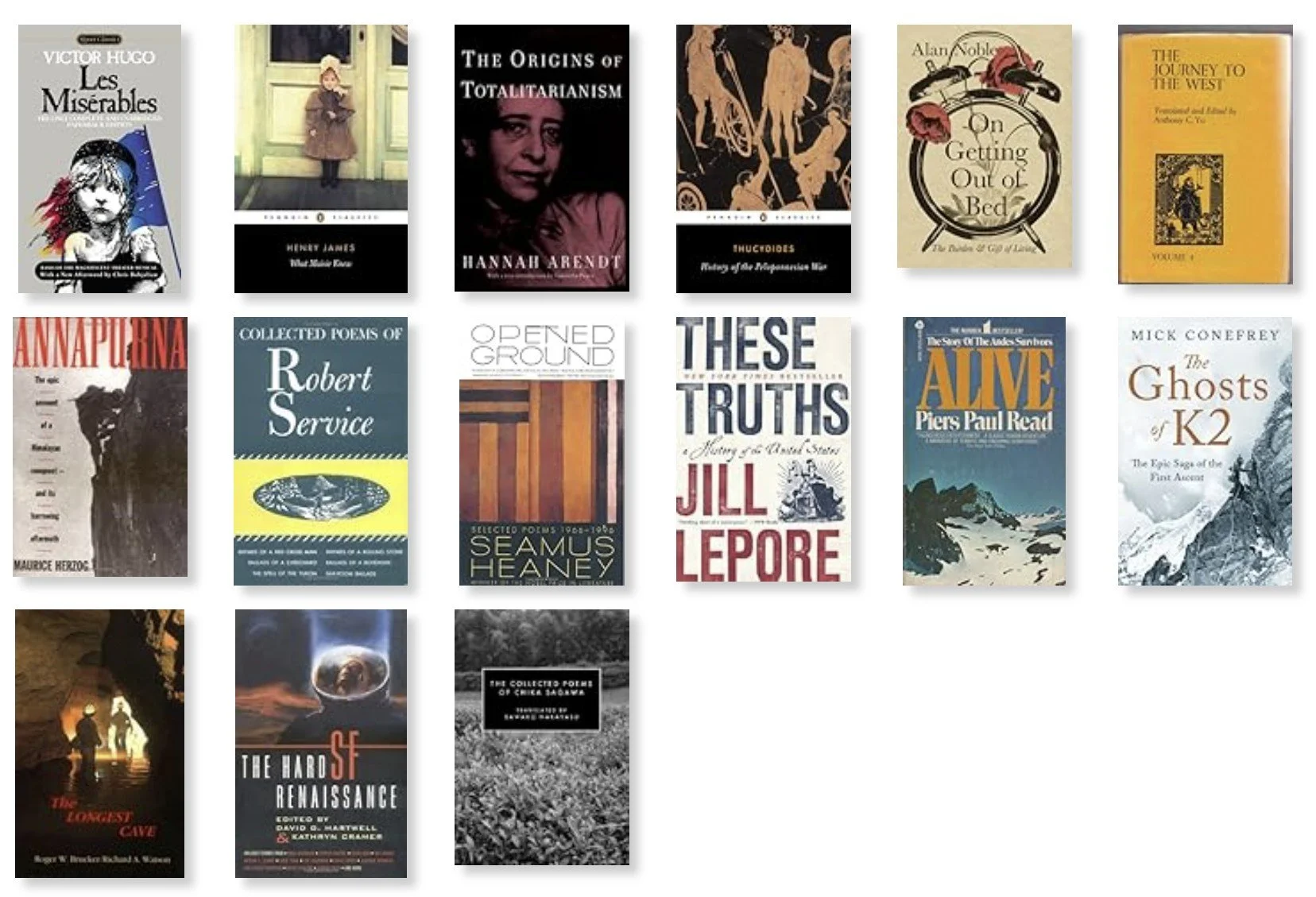
I read 15 books in 2025, which I’m going to rank, but I’ll start with the caveat that none of these were bad. I don’t often read bad books, so don’t read too much into the ranking at the low end. Here is the list: https://www.goodreads.com/review/list/118209919-andrew-bell?shelf=read-in-2025&view=covers
15. The Collected Poems of Chika Sagawa, Chika Sagawa, 1936
Modernist poetry perhaps suffers more in translation than other forms of poetry – or perhaps this is too avant-garde for me to really assimilate. I struggled to connect with these, but they still provide honest and vulnerable glimpses of light from a mind who died far too young and produced an impressive amount of serious verse in her 25 years of life.
14. The Hard SF Renaissance, Anthology, 2002
This is a fascinating collection of science fiction stories. I find that the worldview common to so much hard SF in this period is so bleak and troubling on a philosophical level that I fixate on each story less as science fiction and more as a kind of intellectual horror, which makes them more compelling, if also disturbing to consider as possibilities.
13. The Longest Cave, Roger Bruckner & Richard Watson, 1975
Fun and freewheeling in a way that almost makes you forget that the authors are insane mole-men whose idea of a good time is worming their way miles deep in the unmapped earth through tubes so small that you can’t even crawl properly on hands and knees, but have to slither. As someone morbidly fascinated by the (vicarious) claustrophobia of caving and the romantic danger of extreme exploration, and who also loves extremely detailed and thoroughly-mapped step-by-step accounts of that process of exploration, this is a real good time. I’m glad the authors didn’t die and surfaced long enough to write this book.
12. The Ghosts of K2, Mick Conefrey, 2015
Another very detailed step-by-step account of the process of exploration, this time in the vertical. I’ve been obsessed with expeditions in the Himavant since seeing an IMAX documentary on Everest at the Pacific Science Center as a kid. I was particularly captivated by the fate of Dudley Wolfe, who was good at climbing up and tolerating the altitude, but perhaps felt less surefooted going back down, and so gradually camp-by-camp ratcheted himself higher and higher on the mountain, declining to descend when the others did, waiting out the bad weather high up, spending four weeks above 23,000 feet, and ultimately dying on the mountain, never to be found, and taking his would-be rescuers with him. It combines the spiritual awe of the pilgrimage of ascent with the reverential horror reserved for the slow process of someone walking to their own death, growing weaker and less sane with every step, but too slowly to notice and pull back.
11. Alive, Piers Paul Read, 1973
A story of survival where the headline that draws people in is cannibalism, but the actual story is a kind of total refutation of Lord of the Flies in which a group of young men rise to the unthinkable circumstance which confronts them, form an orderly community amid the ice, and in the house of death come to clearly see the face of God.
10. These Truths, Jill Lepore, 2018
A worthy stab at the project of fashioning American history into myth – a very reasonable and measured liberal myth which attempts to hold together the good and the bad at once, which so many fail at or simply do not attempt, but which is a crucial endeavor if we are to have any hope of a country with both a bright future and a just one.
9. Opened Ground, Seamus Heaney, 1995
The way I read poetry, trying to progress measurably through a book while reading aloud, is perhaps in tension with this style, which does not run rapidly down the tongue. The smell of the damp earth, however, is still in my nostrils. And I found both useful and affecting the way in which he writes about how to write, how to work. See my review for quotes: https://www.goodreads.com/review/show/4451129167
Digging:
Between my finger and my thumb
The squat pen rests; snug as a gun.
Under my window, a clean rasping sound
When the spade sinks into gravelly ground:
My father, digging. I look down
Till his straining rump among the flowerbeds
Bends low, comes up twenty years away
Stooping in rhythm through potato drills
Where he was digging.
The coarse boot nestled on the lug, the shaft
Against the inside knee was levered firmly.
He rooted out tall tops, buried the bright edge deep
To scatter new potatoes that we picked,
Loving their cool hardness in our hands.
By God, the old man could handle a spade.
Just like his old man.
My grandfather cut more turf in a day
Than any other man on Toner’s bog.
Once I carried him milk in a bottle
Corked sloppily with paper. He straightened up
To drink it, then fell to right away
Nicking and slicing neatly, heaving sods
Over his shoulder, going down and down
For the good turf. Digging.
The cold smell of potato mould, the squelch and slap
Of soggy peat, the curt cuts of an edge
Through living roots awaken in my head.
But I’ve no spade to follow men like them.
Between my finger and my thumb
The squat pen rests.
I’ll dig with it.
8. Collected Poems of Robert Service, Robert Service, 1906
Robert Service holds a special nostalgia for me from childhood dreams of the Klondike, now bolstered by the added interest of actually living in the North. I write about this in my blog: https://www.andrewroosbell.com/blog/the-bard-of-the-yukon
7. Annapurna, Maurice Herzog, 1950
A personal and yet personally unsympathetic account of the grand misery of mountaineering. I am so fascinated by the attempt to unfold and pry apart the path into the contorted spires of a reclusive massif made solely through the reckless sacrifice of the human body. Herzog was crazy. I was very happy to follow along on Google Earth, but that is as far as I go.
6. Journey to the West, Wu Cheng’en (?), 1592
You would think the repetition of the pattern of binding and liberating would grow tiresome, yet it never does; for that we must thank the luxury of the poetry, the fundamentally compelling nature of the theme of overcoming evil, and most of all, Sun Wukong for being a delight.
5. On Getting Out of Bed, Alan Noble, 2023
I have found great encouragement in the wisdom in this book, and the frank acknowledgment that life is lived in the face of death, which helps to deal with the daily experience of misery and futility. We must live, regardless! More here: https://www.andrewroosbell.com/blog/on-getting-out-of-bed
4. History of the Peloponnesian War, Thucydides, 411 BC
This feels like it could have been written about our world today and it would play out almost exactly the same. The fact that Thucydides is so spare in his commentary, and yet pours his entire life's somber perspective into it, without ever making it about himself, but only about passing on this one piece of wisdom, which cost so many lives to procure, compels reverence. This also gives us the Melian Dialogue, the aphorism of amoral power in foreign relations, which we must gaze into like the fire, and then reject fully as a way of making policy: “you know as well as we do that right, as the world goes, is only in question between equals in power, while the strong do what they can and the weak suffer what they must.”
3. The Origins of Totalitarianism, Hannah Arendt, 1950
One of the most impressive and startling books I’ve read, and one I continue to think about. More here: https://www.andrewroosbell.com/blog/the-origins-of-totalitarianism
2. What Maisie Knew, Henry James, 1896
This is one of the best novels I've ever read. There's nothing so astonishing as James's prose, hard and crystalline and expansive as ever, placed fully at the service of a realistic child's perspective.
“The litigation had seemed interminable and had in fact been complicated; but by the decision on the appeal the judgment of the divorce-court was confirmed as to the assignment of the child. The father, who, though bespattered from head to foot, had made good his case, was, in pursuance of this triumph, appointed to keep her: it was not so much that the mother’s character had been more absolutely damaged as that the brilliancy of a lady’s complexion (and this lady’s, in court, was immensely remarked) might be more regarded as showing the spots. Attached, however, to the second pronouncement was a condition that detracted, for Beale Farange, from its sweetness – an order that he should refund to his late wife the twenty-six hundred pounds put down by her, as it was called, some three years before, in the interest of the child’s maintenance and precisely on a proved understanding that he would take no proceedings: a sum of which he had had the administration and of which he could render not the least account. The obligation thus attributed to her adversary was no small balm to Ida’s resentment; it drew a part of the sting from her defeat and compelled Mr. Farange perceptibly to lower his crest. He was unable to produce the money or to raise it in any way; so that after a squabble scarcely less public and scarcely more decent than the original shock of battle his only issue from his predicament was a compromise proposed by his legal advisers and finally accepted by hers.
His debt was by this arrangement remitted to him and the little girl disposed of in a manner worthy of the judgment-seat of Solomon. She was divided in two and the portions tossed impartially to the disputants. They would take her, in rotation, for six months at a time; she would spend half the year with each. This was odd justice in the eyes of those who still blinked in the fierce light projected from the tribunal – a light in which neither parent figured in the least as a happy example to youth and innocence. What was to have been expected on the evidence was the nomination, in loco parentis, of some proper third person, some respectable or at least some presentable friend. Apparently, however, the circle of the Faranges had been scanned in vain for any such ornament; so that the only solution finally meeting all the difficulties was, save that of sending Maisie to a Home, the partition of the tutelary office in the manner I have mentioned. There were more reasons for her parents to aggree to it than there had ever been for them to agree on anything; and they now prepared with her help to enjoy the distinction that waits upon vulgarity sufficiently attested. Their rupture had resounded, and after being perfectly insignificant together they would be decidedly striking apart. Had they not produced an impression that warranted people in looking for appeals in the newspapers for the rescue of the little one – reverberation, amid a vociferous public, of the idea that some movement should be started or some benevolent person should come forward? A good lady cam indeed a step or two: she was distantly related to Mrs. Farange, to whom she proposed that, having children and nurseries wound up and going, she should be allowed to take home the bone of contention and, by working it into her system, relieve at least one of the parents. This would make every time, for Maisie, after her inevitable six months with Beale, more of a change.
‘More of a change?’ Ida cried. ‘Won’t it be enough of a change for her to come from that low brute to the person in the world who detests him most?’
‘No, because you detest him so much that you’ll always talk to her about him. You’ll keep him before her by perpetually abusing him.’
Mrs. Farange stared. ‘Pray, then, am I to do nothing to counteract his villainous abuse of me?’
The good lady, for a moment, made no reply: her silence was a grim judgment of the whole point of view. ‘Poor little monkey!’ she at last exclaimed; and the words were an epitaph for the tomb of Maisie’s childhood. She was abandoned to her fate. What was clear to any spectator was that the only link binding her to either parent was this lamentable fact of her being a ready vessel for bitterness, a deep little porcelain cup in which biting acids could be mixed. They had wanted her not for any good they could do her, but for the harm they could, with her unconscious aid, do each other. She should serve their anger and seal their revenge, for husband and wife had been alike crippled by the heavy hand of justice, which, in the last resort, met on neither side their indignant claim to get, as they called it, everything. If each was only to get half, this seemed to concede that neither was so base as the other pretended, or, to put it differently, offered them as both bad indeed, since they were only as good as each other. The mother had wished to prevent the father from, as she said, ‘so much as looking’ at the child; the father’s plea was that the mother’s lightest touch was ‘simply contamination’. These were the opposed principles in which Maisie was to be educated – she was to fit them together as she might.”
1. Les Miserables, Victor Hugo, 1862
One of the best books I have ever read. https://www.andrewroosbell.com/blog/les-miserables